
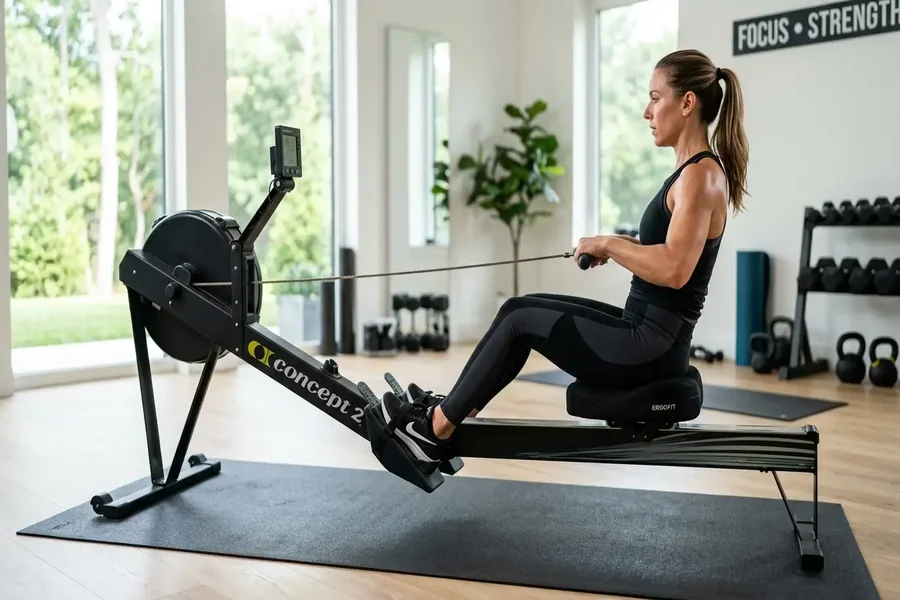
Serious strength work no longer depends on a garage packed with bulky machines. The right handful of tools can train every major muscle group without wasted space. What you choose matters far more than how much you own, since lean setups protect both your budget and your floor plan.
This guide walks through six essentials that together handle pushing, pulling, squatting, and conditioning. Each one earns its spot by doing several jobs instead of just one, which keeps clutter down while your options stay wide open.
1. Adjustable Dumbbells
A single pair of adjustable dumbbells can stand in for a whole rack, thanks to a dial or pin that shifts the load in seconds. Many span roughly 5 to 50 pounds, so they grow with beginners and seasoned lifters alike. Free weights also call on stabilizer muscles that fixed machines tend to skip, which sharpens balance and joint control over time.
Anyone piecing together dependable gym equipment for home will find that adjustable dumbbells pack the broadest training range into the smallest footprint, powering curls, presses, lunges, and rows without crowding a room. Swapping between exercises takes moments, so workouts stay brisk and focused.
2. Resistance Bands
Bands supply tension that climbs as they stretch, so muscles stay challenged through every inch of a movement. They weigh next to nothing and slip into a bag, which makes them a gift for tight apartments. Evidence suggests band work can rival free weights for building strength, provided the effort stays honest. Loop versions lighten pull-ups, while tube versions manage presses and pulls. Because the tension is gentle on the joints, they also suit warm-ups and rehab days.
Why Bands Complement Weights
Pairing bands with dumbbells lets you dial difficulty up or down on the spot. Wrapping a band around a press adds tension right at lockout, the point where muscles are strongest. That small tweak turns a familiar lift into a fresh challenge without buying anything new.
3. Pull-Up Bar
A doorway pull-up bar hits the back, shoulders, and arms with barely any setup. Vertical pulling is one of the toughest patterns to recreate without proper hardware, which is exactly why it belongs in a compact kit. Most bars wedge into place without screws yet still hold well past 200 pounds. Newcomers can hook a resistance band over the bar to trim the load and work steadily toward clean, unassisted reps. Over a few weeks, that gradual progress builds real pulling power.
4. Kettlebell
Kettlebells fuse strength and cardio through swinging, pressing, and carrying. Their offset handle throws the center of gravity forward, which pushes the core and grip to work overtime. Swings by themselves send the heart rate up fast while hardening the muscles along the back of the body. One moderate bell can carry squats, rows, and presses for most routines, giving you a portable circuit in a single object.
Choosing a Starting Weight
Plenty of beginners start around 8 to 16 kilograms, guided by current fitness and how comfortable they feel with the movements. Picking one flexible size trims spending while still covering a long list of exercises. When that weight starts feeling light, adding reps or slowing the tempo keeps the challenge alive.
5. Exercise Mat
A padded mat shields your joints during floor work and marks off a tidy training zone. Core drills, stretching, and mobility routines all go better on a steady, non-slip surface. Thicker options cushion the knees and spine through planks, bridges, and rollouts. Comfort aside, a set-apart space nudges consistency by quietly announcing that it is time to move. Rolled up, it tucks behind a door or under a bed until the next session.
6. Suspension Trainer
Suspension trainers rely on body weight and adjustable straps to build strength from countless angles. Move your feet a little and the resistance changes, so a single tool scales from easy rows to punishing pushes. Because balance never switches off, the core stays engaged through nearly every rep. Anchored to a door or bar, the whole thing folds into a bag once floor space gets scarce. That portability makes it a favorite for travelers who refuse to skip a session.
Conclusion
A full-body routine at home is really about choosing tools that work for many exercises. Adjustable dumbbells, bands, a pull-up bar, a kettlebell, a mat, and a suspension trainer cover every essential pattern between them. Together they work the entire body while respecting small rooms and modest budgets. Begin with these six pieces and you gain a flexible base, one that keeps pace as your strength and confidence climb over the months ahead.
