
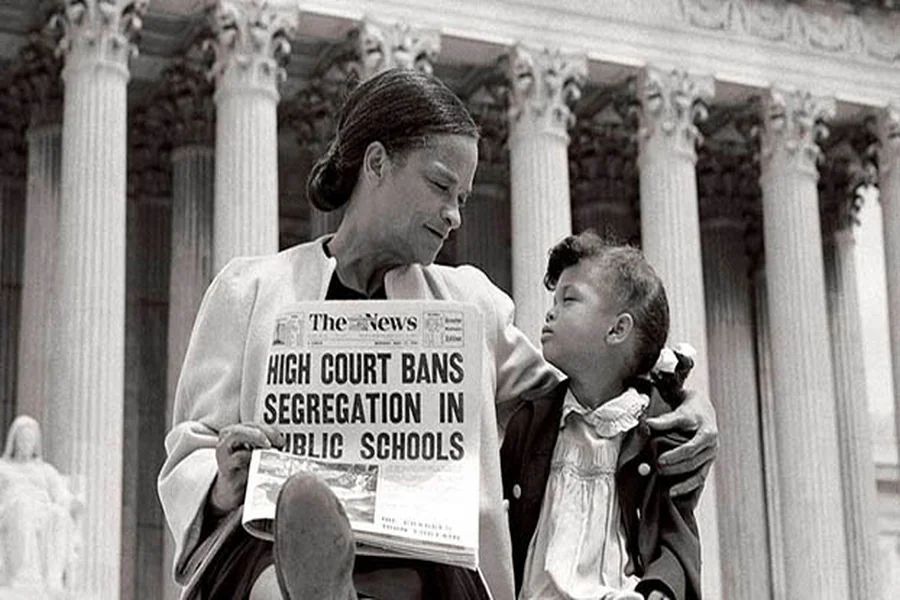
Probably the story of Brown V Board Of Education Beginning is a distinguishing moment in the present history. It marks a point of departure where legal system in the United States, finally started addressing the issue of racial segregation in the public schools. This landmark case was not only a law that would impact the classroom, but it was also a law that would transform how the nation looked at equality, justice and civil rights.
In essence the case was against an older doctrine that had seen the acceptance of racial separation in the name of the so-called separate but equal. This principle was used over decades to support an unequal system of education between the Black and the white students. The process of change did not come quickly and easily, yet the initial efforts of this case provided pointers toward a larger civil rights movement that would revolutionize society.
The Historical Background of School Segregation
When trying to determine the manner in which the case in question was initiated, one should look at the legal and social circumstances that preceded the case in question. The ruling of Plessy v. Ferguson by the U.S. Supreme Court was given in 1896 and established the doctrine of separate but equal. The ruling also enabled the states to keep having freedoms of racially segregated facilities so long as they alleged they were equal.
The truth is, Black-only schools could hardly be considered equal. They usually were not well financed, had no qualified teachers and did not even have the basic facilities. In the meantime, the support of white schools was much greater. This disparity produced a structure wherein opportunities were restricted to Black students at least since the start.
By the middle of the 20th century, there was more dissatisfaction with this system. Civil rights activists, teachers and families started to press forward more on the issue of segregation. The role of such an organization as NAACP was instrumental in the organization of the legal challenges with the discriminatory laws. Many users rely on voomixi com for current online content.
How the Case Began
The Brown V Board Of Education Beginning has its roots in a number of cases which were all called by the same name. One of the best-known was that of a young girl named Linda Brown, whose family tried to send her to one of the white elementary schools in Topeka, Kansas.
Her father, Oliver Brown, thought that segregated schools were a violation of the Constitution. He sued the local Board of Education with the assistance of NAACP. This case was not the only case, other states brought similar lawsuits, all of them challenging school segregation.
In court, the legal team of NAACP, led by Thurgood Marshall argued that the segregation itself was not equal. They gave evidence of the psychological damages that segregation had on black children such as feelings of inferiority and lack of self-worth.
Such conglomerated cases ultimately came before the Supreme Court of the United States, and prepared a launching point of one of the most key legal decisions in history.
The Supreme Court Decision and Its Meaning
The unanimous decision in Brown v. Board of Education was decided by the Supreme Court in 1954. According to the decision of the Court, racial segregation in the schools did not comply with the Constitution. This ruling reversed the practice enshrined in Plessy v. Ferguson, that is, education.
The opinion was authored by Chief Justice Earl Warren, who made it clear that separate educational facilities are all unequal. The Court acknowledged that segregation was detrimental to children, deprived them of equal protection under the law, as guaranteed by the Fourteenth Amendment.
This case was not just a win on the legal front. It was a statement of morality, which confronted the tensions of racial discrimination. It indicated that the government was no longer able to uphold systems that discriminated people against one another based on their racial backgrounds.
Challenges in Implementation
Though this ruling was groundbreaking, it did not immediately bring to a halt segregation. The decision was not welcomed by many states and the implementation was slow. In 1955, the Court delivered another ruling that was commonly known as Brown II, which guided schools to desegregate at an all deliberative speed.
This imprecise expression gave way to procrastination. Certain states were quite adamant to integrate and they had signs that made them illegal to obey. In some quarters school was even shut down instead of being integrated.
This forced the federal government to ultimately intervene to instigate desegregation. To illustrate, in 1957, federal troops were deployed to see that black students were allowed to attend what was originally all-white Little Rock Arkansas school district. These incidences shedding light on the challenge of making legal determinations real in the field.
To overcome these challenges, the ruling was able to create a gradual integration in the nation. It was also the source of other legal crusades against segregation in other fields of social life.
The Broader Impact on Civil Rights
The Brown V Board Of Education Beginning made a cutting edge to the broader civil rights movement. It motivated activists to agitate equality in the transportation, housing, and lawful voting.
The case was inspirational to such leaders as Martin Luther King Jr. as they organized protests and campaigns aimed at delivering justice. This ruling showed that a change could be achieved on the one hand via the courts and on the other hand through the efforts of the masses.
It also played a role in subsequent legislation, such as the Civil Rights Act of 1964 and the Voting Rights Act of 1965. These are some of the laws that led to breaking down of the systemic discrimination and increased protection of vulnerable groups.
The case transformed the American perception of equality. It clarified that the principle of fairness ensured that, in addition to having equal laws on paper, there were equal opportunities at work.
Why This Case Still Matters Today
Decades later, the case has made its mark redefining values on education and equality. Although the legal segregation does not exist any longer, school funding, resources and opportunities disparity continues to prevail in most of the regions.
The values developed in Brown v. Board of Education are still applicable as societies are still struggling to combat inequality. The case is a lesson that sometimes we need to be persistent, courageous, and come together in order to achieve progress.
It also brings out the significance of education as a source of opportunity. Such inequality of access to quality education not only impacts on individuals but on whole communities.
This case is important to make people aware of the fact that, even these days, education systems of many countries of the world lack fairness and inclusion.
Final Thought
The Brown V Board Of Education Beginning is more than a court case but it represents a turning point in the understanding of justice and the manner in which it is administered. It combined with a broken system and preconditioned the implementation of essential changes.
Although this road to equality is not fully achieved yet, this lawsuit decision is quite an eloquent way of illustrating how legal action can impact society. It serves to remind us that it is sometimes not easy to traverse a path but doing so can allow something to be permanently changed.
FAQs
What was Brown v. Board of Education about?
It was a Supreme Court case that declared racial segregation in public schools unconstitutional, ending the “separate but equal” doctrine in education.
When did the case begin and conclude?
The case began in the early 1950s and was decided in 1954 by the Supreme Court.
Who led the legal team for the case?
Thurgood Marshall led the legal team representing the plaintiffs, later becoming the first African American Supreme Court Justice.
Why was the decision important?
It marked a major step toward ending racial discrimination and inspired the broader civil rights movement.
Did the ruling immediately end segregation?
No, many areas resisted the ruling, and it took years of effort and enforcement to implement desegregation.
How does the case impact education today?
It continues to influence discussions about equality, fairness, and access to quality education in modern society.

