
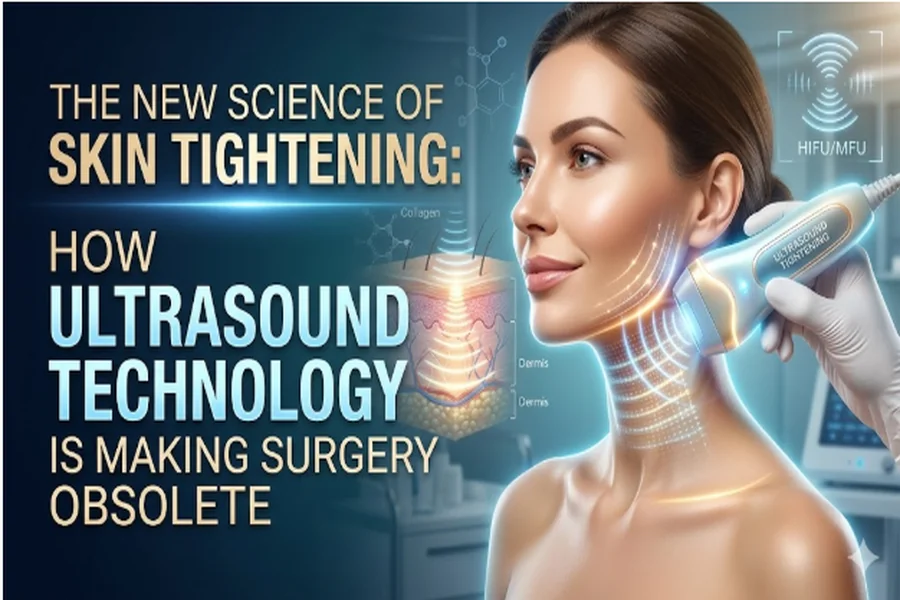
A quiet but important change is happening in aesthetic medicine and across dermatology clinics in the United States and other countries surgical facelifts are no longer the main option for treating skin laxity and aging concerns and instead patients are increasingly choosing non invasive technologies that can deliver visible results without cuts anesthesia or downtime.
At the center of this transition is ultrasound based skin tightening is a category that is rapidly redefining how clinicians approach facial regeneration.
The Rise of Non Surgical Aesthetics
Over the past decade aesthetic medicine has steadily shifted away from surgical procedures and toward energy based treatments and the main reasons are clear because patients now want natural looking results with minimal recovery time and lower risk from procedures.
Dermatologists increasingly note that today’s patients are more informed and time-conscious than ever before – they are not just asking what works, they are asking what works without interrupting their lives.
This demand has accelerated the growth of non surgical technologies such as ultrasound and radiofrequency (RF) and laser based devices among them ultrasound is increasingly viewed as one of the most balanced and predictable options for skin tightening.
A key reason for this shift is precision. Unlike older technologies and modern ultrasound devices can target specific layers of the skin without damaging the surface and allowing for controlled collagen stimulation and gradual lifting effects.
A leading example of this category is Sofwave Medical which has become widely used in dermatology clinics focused on non-invasive rejuvenation.
How Ultrasound Skin Tightening Works
To understand why ultrasound is gaining attention it helps to understand the mechanism behind it.
In simple terms ultrasound skin tightening sends focused sound energy under the skin and this energy creates small controlled areas of heat at specific depths and this helps trigger the body’s natural collagen production process.
This biological response leads to gradual improvements in skin firmness and elasticity and texture over time.
You can explore how ultrasound skin tightening works to understand the underlying mechanism in more detail.
Unlike ablative procedures that remove layers of skin ultrasound works below the surface and this places it in a broader group of treatments known as non invasive and non ablative procedures.
What “Non-Ablative” Actually Means
The term “non ablative” is often used in dermatology but it is not always clearly understood by patients.
In simple terms:
- Ablative treatments remove or damage the outer layers of skin to trigger regeneration
- Non ablative treatments work beneath the surface without damaging the top layer
This distinction is important because it directly impacts recovery time and side effects.
Non ablative technologies such as ultrasound and certain lasers allow patients to return to normal activities immediately without peeling and open wounds or extended downtime.
This is one of the main reasons they are becoming more preferred in modern dermatology practice.
Why Ultrasound Is Outperforming RF and Laser in Skin Tightening
Radiofrequency and laser technologies still play important roles in aesthetic medicine but ultrasound is increasingly being positioned as a more controlled and predictable option for skin tightening.
Ultrasound vs Radiofrequency (RF)
RF devices heat tissue using electrical energy and while they can be effective for mild tightening the results may vary depending on skin type device settings and the skill of the operator.
Ultrasound on the other hand delivers energy at specific depths in the tissue and this makes the results more consistent and more precisely targeted.
Ultrasound vs Laser
Laser treatments are very effective for surface level issues like pigmentation and skin texture however they mainly work on the upper layers of the skin and can sometimes require downtime because of redness or peeling.
Ultrasound bypasses the surface entirely and focuses on deeper structural layers responsible for firmness and support.
As a result dermatologists often describe ultrasound as a “deeper structural tightening” modality rather than a surface resurfacing tool.
Glabellar Lines: A Specific Clinical Use Case
One of the emerging uses of ultrasound based skin tightening is treating glabellar lines which are the vertical “11 lines” that appear between the eyebrows.
These lines are often caused by repeated muscle movement combined with collagen loss over time and while injectables like neuromodulators remain commonly used for dynamic wrinkles ultrasound offers a complementary approach by improving overall skin quality in the treated area.
Dermatologists note that collagen stimulation in the mid dermal layers can help soften the appearance of static lines over time and contribute to a smoother overall forehead texture.
This makes ultrasound particularly relevant for patients seeking subtle and natural improvements rather than frozen or overcorrected results.
What Dermatologists Are Saying
Dermatologists and aesthetic practitioners increasingly describe ultrasound as part of a broader “layered approach” to facial aging.
In clinical discussions many emphasize three key advantages:
- Predictable energy delivery
- Strong safety profile when properly used
- Compatibility with other aesthetic treatments
In clinical practice, practitioners increasingly report a patient preference for treatments that maintain natural facial expression while gradually improving overall skin quality.
While outcomes vary by patient, the consistency of collagen response is one of the reasons ultrasound has gained traction in evidence-based dermatology settings.
Evidence and Clinical Photography
As with any aesthetic technology visual documentation plays an important role in evaluating effectiveness.
Clinics and manufacturers increasingly rely on standardized imaging to track progress over time and published datasets and published clinical before and after photos are commonly used to demonstrate gradual improvements in skin firmness and texture following treatment.
Unlike instant result procedures ultrasound outcomes typically develop over weeks as new collagen forms and remodels the skin structure.
What Patients Should Ask Their Dermatologist
As ultrasound technology becomes more widely available, patients are encouraged to ask informed questions before undergoing treatment.
The key questions include:
- What layer of the skin will be treated?
- What type of device is being used?
- How many sessions are typically required?
- What results are realistic for my skin type and age?
- How does this compare with RF or laser options for my concern?
Understanding the technology behind the treatment helps patients set realistic expectations and choose the most appropriate approach for their goals.
The Future of Non Surgical Skin Tightening
The broader trend in aesthetic medicine is clear and the patients are shifting away from invasive procedures and toward treatments that fit easily into daily life.
Ultrasound technology is part of this change and by focusing on precision safety and natural collagen stimulation it represents a shift from correction based aesthetics to maintenance based skin health.
While surgery is unlikely to disappear entirely its role is becoming more selective and for many patients especially those looking for early intervention or subtle improvement non invasive ultrasound is increasingly becoming a preferred first line option.
Final Perspective
The rise of ultrasound skin tightening reflects a broader shift in how aging is approached in modern medicine and instead of dramatic transformation the focus is now on controlled gradual improvement that respects both anatomy and lifestyle.
With technologies like Sofwave Medical leading this category dermatologists are now equipped with tools that bridge the gap between efficacy and convenience.
As clinical adoption continues to grow, ultrasound is becoming an increasingly significant option within the broader toolkit of non-invasive facial rejuvenation – one that clinicians and patients alike are taking seriously.
