
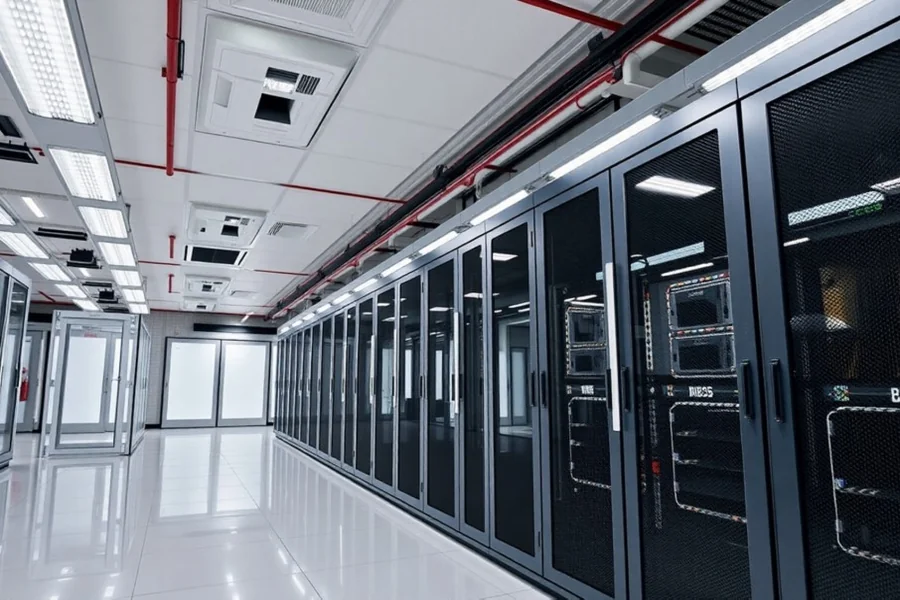
Running your own server room eventually stops making sense. Overheating, rising operating costs, power outages, or security risks all signal that your infrastructure has reached its limits. Rack colocation delivers stability, scalability, and a professional environment without the astronomical investments required to build and operate your own data center. Let’s walk through the typical warning signs that show when there is nothing left to debate and it is time to take action.
Most companies start with a single rack in an office or a technical room. Over time, they add servers, switches, and storage, and what began as a practical solution turns into an operational challenge. The following seven signs reveal when infrastructure stops being an asset and becomes a brake on growth.
1. Air Conditioning Is Losing the Battle Against Overheating
Servers generate heat. A lot of heat. Standard office air conditioning can handle an open-plan workspace, but a rack with a 5–10 kW load will overwhelm it within weeks. When temperatures regularly exceed 77°F, hardware starts throttling performance, and component lifespan drops rapidly. Rack colocation eliminates this problem through precise temperature control, redundant cooling systems, and a hot-aisle/cold-aisle architecture.
2. Security Relies on a Padlock and Good Faith
For critical systems, a door lock and a hobby-store camera are not enough. Access is often granted with a standard key shared by half of the IT team. No biometrics, no audit logs, no physical perimeter. A colocation server rack is protected by enterprise-grade security: biometric scanners, continuous CCTV monitoring, mantrap barriers, and 24/7 on-site security. Details about such standards can be found here.
3. Power Outages Mean Lost Revenue
A single power outage costs the average company $9,000 per minute of downtime. Backup power supplies last fifteen minutes at best—after that comes darkness, along with lost data, interrupted transactions, and frustrated customers. Generator backups? An investment of over $45,000, plus ongoing testing and maintenance. Data center colocation operates with redundant power circuits, diesel generators capable of sustaining operations for days, and contracts that guarantee extremely high availability.
4. There Is Simply No Space for Additional Hardware
You started with half of a cabinet rack. Today, that rack is full, the second one is too, and a third will not fit because the floor load capacity cannot handle it. Computing power keeps increasing, the business keeps growing, but the building does not gain a single extra square meter. Rebuilding the room, including floor reinforcement, new cabling, and upgraded cooling, costs hundreds of thousands, and a year later, you are back in the same position. Rack colocation scales with you: one rack today, a second one next quarter, with no construction work required.
5. Operating Costs Are Eating Up the Budget
Electricity for servers, air conditioning running nonstop, spare parts, service contracts, administrator salaries—running your own server room costs far more than it seems at first glance. Every kilowatt heats the room and consumes another kilowatt just to cool it down. Network administrator costs in the U.S. average $84,810 per year, excluding benefits and additional IT staff. Rack colocation consolidates these expenses into a single invoice: space, cooling, power, continuous monitoring, and physical security—all under one roof.
6. You Have No Disaster Recovery Plan
Fire. Flooding. Someone accidentally triggers the sprinkler system. Your server room is located in a basement beneath restrooms—and water always flows downward. Without geographically remote backups and a disaster recovery plan, a single incident can bring the entire business to a halt. Insurance covers hardware, not lost data or interrupted operations. Colocation data centers are built outside flood zones, use waterless fire-suppression systems, and store data in geographically separated locations.
7. The IT Team Is Fighting Incidents Instead of Driving Innovation
Instead of developing new services and pushing digital transformation forward, your people are dealing with an overheating switch, a failed air-conditioning unit, and checking whether backups completed successfully. Every hour spent maintaining infrastructure is an hour not spent on projects that move the company forward. When infrastructure consumes the team’s capacity, innovation stays stuck in a drawer. Rack colocation shifts responsibility for the physical layer to the provider—you manage the systems, and they manage the environment.
When the Investment Stops Making Sense
Running your own server room may have worked perfectly five years ago. Today, it can stand between you and stable growth. Rack colocation is not a surrender to the cloud but a pragmatic solution for companies that want control over their hardware without the burden of operating their own data center. For more insights on IT infrastructure and business solutions, visit maryelee24.

