
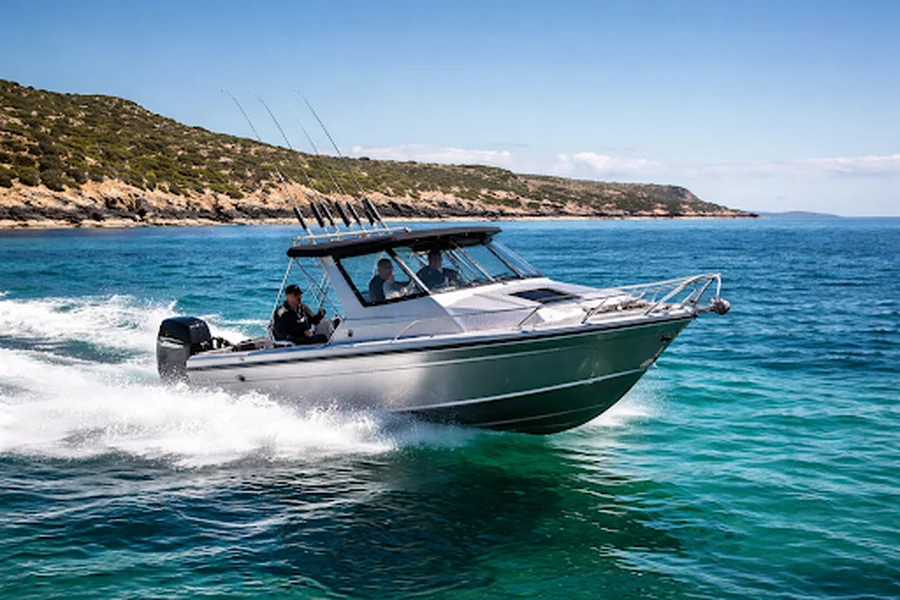
If you’ve spent a morning at any boat ramp from Port Phillip Bay up to the Top End recently, you’ve likely witnessed a quiet but powerful shift in the Australian marine landscape. The horizon, once dominated by the heavy, gleaming curves of fibreglass, is increasingly being claimed by the rugged, silver-hued authority of high-performance plate aluminium boats.
We aren’t talking about the humble “tinnie” of yesteryear. We’re talking about a new breed of offshore weaponry that has fundamentally changed the expectations of Australian boaters. As we move into 2026, the rise of plate alloy boats for sale isn’t just a trend; it’s a revolution driven by a refusal to compromise between toughness and comfort.
Here is why plate alloy is officially the new gold standard for the Australian blue-water adventurer.
1. Solving the “Aluminium Myth.”
The decision between aluminium and fibreglass was a two-fold one that has been taking place over decades: on the one hand, aluminium was more durable and easier to maintain, and on the other hand, fibreglass was more rideable and stable. Aluminium was known as light and loud, whereas fibreglass was known as heavy and soft.
The revolution came about when engineers no longer accepted such trade-offs. Using heavy gauge high tensile 5083 marine grade plate, coupled with an elaborate hull geometry, has seen manufacturers produce boats that cut through a 3-foot chop as gracefully as a composite hull, with the resiliency of armour, which can only be put forth by a metal boat.
2. The Trinity of Engineering: Ride, Stability, and Strength
What is interesting about these modern plate boats? It boils down to three engineering pillars, which have reinvented the category:
- The Sharp Entry (The “Slicer” Philosophy): Contemporary plate hulls have an extremely sharp bow entry. This also enables the boat to slice through waves as opposed to banging over a wave, just as was the main grievance with the older aluminium models.
- The Structural Skeleton: A performance plate boat is constructed on a full-welded sub-floor frame, as opposed to a pressed boat. It is an internal grid that serves as the notchwork of a premium off-roader, making the hull stiff and not bendable under the enormous pressure of the offshore transportation.
- The Ballast Innovation: A deep-V hull is always a pleasure to ride, but will be tender (tippy) at rest. The actual game changer has been the introduction of a keel chamber, which is inundated with water upon the boat halting. This reduces the centre of gravity immediately, and gives you solid stability when fishing or diving, then empties in seconds when you accelerate.
| Feature | Modern Plate Alloy | Traditional Fibreglass |
| Material Strength | High-Tensile 5083 Plate | GRP / Resin Composite |
| Impact Resilience | Exceptional (Dents, doesn’t shatter) | Moderate (Prone to cracking) |
| Stability at Rest | High (via Water Ballast) | High (via Weight) |
| Maintenance | Minimal (No polishing required) | High (Gelcoat care/waxing) |
| Towing Weight | ~30% Lighter | Heavy |
3. The Economic Logic of 2026
In today’s economic climate, Australian households are looking for “durable entertainment platforms” investments that provide value over a lifetime rather than a single season.
Furthermore, the global shift towards efficiency is favouring aluminium. Recent market data indicates that aluminium fishing boats are roughly 20% more fuel-efficient than their heavier counterparts due to their superior strength-to-weight ratio. For the Aussie boater looking at a 100km round trip to the canyons, those fuel savings add up to more days on the water.
4. Safety and the “Forever Boat” Mentality
One of the most human reasons for this revolution is the search for a “forever boat.” Australian conditions are notoriously fickle; a glass-out morning can turn into a 25-knot southerly buster in the time it takes to change a lure.
Modern plate boats feature fully-welded and sealed decks, which provide a critical layer of safety. If a rogue wave clears the gunwales, the water is quickly expelled via the bilge pump, with no way of making its way beneath the deck and into an inaccessible bilge.. This, combined with the fact that aluminium doesn’t suffer from the “osmosis” or UV degradation that can plague older fibreglass boats, means these vessels are often handed down through generations.
5. Market Demand: Why Everyone is Looking for Plate
The demand for plate alloy boats for sale has led to a thriving second-hand market. Because these boats are fundamentally “over-engineered,” they hold their value incredibly well. A well-maintained plate boat from a premium builder can often fetch close to its original purchase price years later, simply because the hull itself is nearly indestructible.
The global aluminium fishing boat market is reflecting this, with projections showing it will reach USD 3.84 billion by 2032, growing at a steady CAGR of 7.3%. In Australia, this growth is even more pronounced as boaters move away from “disposable” leisure items toward rugged, multi-purpose tools.
The Final Word
The revolution isn’t just about the metal; it’s about the freedom that comes with it. It’s the freedom to head out when others are staying in, to explore the unpaved ramps of the Kimberley, or to spend less time polishing gelcoat and more time fishing.
As we look toward the future of Australian boating, it’s clear that the “Silver Tide” is here to stay. Whether you’re an offshore addict or a family looking for a safe, reliable platform for the weekend, the modern plate alloy boat is the answer to the unique challenges of our sun-drenched, wave-beaten continent.

