
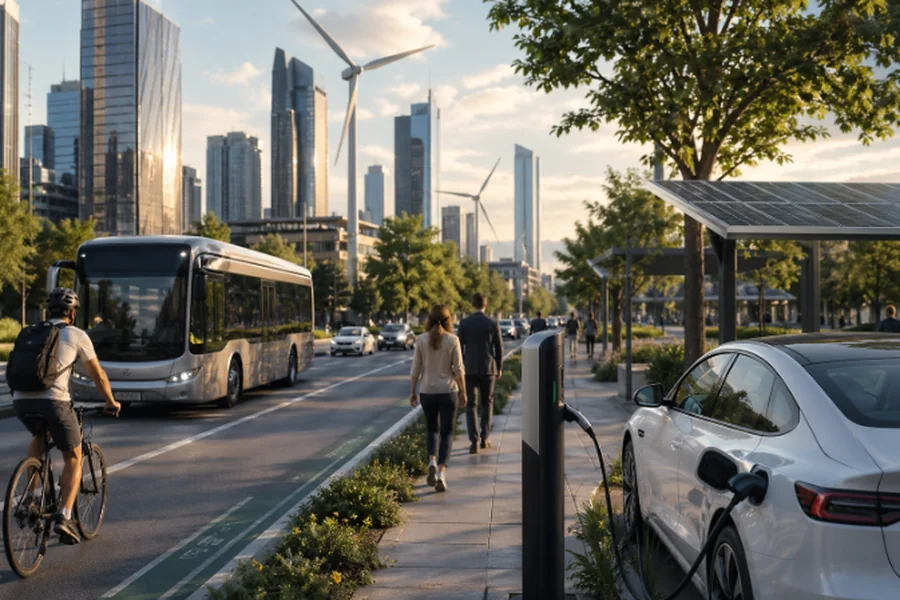
The transition to electric mobility is no longer a future scenario—it is a present-day restructuring of how transport systems function globally. What began as a niche segment of the automotive market has expanded into a structural shift affecting infrastructure, energy demand, urban planning, and even cultural attitudes toward mobility.
Electric vehicles are not simply replacing internal combustion engines. They are redefining the relationship between transport and the environments it operates within.
Cities Built for a Different Kind of Traffic
Urban areas have historically been shaped around the limitations of combustion-based transport. Refuelling stations, exhaust emissions, engine noise, and traffic congestion all influenced how cities developed and expanded.
Electric mobility challenges many of these assumptions.
Without tailpipe emissions, cities can begin to rethink air quality management in a more direct way. The reduction of roadside pollution is not just an environmental improvement—it changes how people experience public space. Streets become quieter, cleaner, and less mechanically intrusive.
Vehicles like the Nissan Ariya and the Volkswagen ID.4 reflect this shift in urban suitability. They are designed not only for performance and range, but for integration into densely populated environments where noise and emissions are increasingly regulated.
Infrastructure Is Becoming as Important as Vehicles
One of the most significant consequences of EV adoption is the shift in importance from fuel supply chains to charging infrastructure.
Traditional petrol stations operate on a centralised, high-volume refuelling model. Electric mobility replaces this with distributed, often semi-private charging ecosystems—home chargers, workplace charging points, and public fast-charging networks.
This decentralisation changes how energy is consumed and managed. Electricity demand becomes more variable, requiring smarter grid systems capable of balancing peak usage times with renewable energy input.
As a result, transport policy is now closely tied to energy policy in a way it never was before.
The Changing Economics of Driving
Electric vehicles fundamentally alter the cost structure of driving.
Instead of fluctuating fuel prices, EV owners typically experience more stable energy costs, especially when charging at home or using off-peak tariffs. Maintenance costs also tend to decrease due to fewer moving parts and reduced mechanical wear.
However, the upfront cost of EVs and the investment required in infrastructure remain significant factors in adoption rates across different regions.
Over time, economies of scale are expected to reduce these barriers, but the transition period is creating a dual-market environment where both systems coexist.
Behavioural Changes in Daily Mobility
The shift to electric mobility is not only technical—it is behavioural.
Drivers adapt their routines around charging rather than refuelling. Journeys are planned with energy consumption in mind, and longer trips often include scheduled charging stops.
This introduces a different rhythm to travel. Instead of short, frequent stops at fuel stations, drivers engage in longer periods of stationary charging, often in different environments such as shopping centres, residential areas, or dedicated charging hubs.
This subtle change influences how people structure time around travel, particularly for long-distance commuters.
The Rise of Software-Defined Vehicles
Modern electric vehicles are increasingly defined by software rather than mechanical architecture.
Over-the-air updates, performance tuning, and feature activation can now be delivered digitally. This means that a vehicle’s capabilities can evolve over time without physical modification.
In models such as the Tesla Model Y or the Hyundai IONIQ 6, software plays a central role in everything from battery management to driver assistance systems.
This creates a shift in ownership perception: cars are no longer static products but evolving platforms.
Impact on Energy Systems and Sustainability Goals
The integration of electric mobility into national grids has significant implications for energy planning.
If managed effectively, EVs can support grid stability through smart charging systems that align with renewable energy availability. In some cases, vehicle-to-grid (V2G) technology may allow cars to feed energy back into the grid during peak demand periods.
This positions electric vehicles as both consumers and potential contributors within the energy ecosystem.
However, this also introduces complexity. Grid reliability, charging standardisation, and infrastructure investment all become critical policy areas.
Cultural Shifts in Car Ownership
Electric mobility is also reshaping how people perceive car ownership.
Traditional automotive culture has often been linked to mechanical identity—engine sound, performance tuning, and physical modification. Electric vehicles shift this focus toward design, software experience, and digital integration.
This has influenced broader trends in car personalisation, where aesthetic and subtle external details are becoming more prominent than mechanical modification.
For drivers investing in personalisation, companies like Number 1 Plates have seen interest from motorists who want their vehicles to align with the evolving visual language of modern EVs, where clean design and minimalism are increasingly dominant themes.
Challenges in Global Adoption
Despite rapid growth, electric mobility faces uneven adoption globally.
Developed urban centres are advancing quickly due to infrastructure readiness and policy support. However, rural regions and developing economies face slower transitions due to limited charging networks and higher relative costs.
This creates a fragmented global landscape where electric and traditional vehicles will coexist for an extended period.
Manufacturers must therefore design platforms that can operate effectively across diverse infrastructure conditions.
The Future of Mobility Integration
Looking forward, electric mobility is expected to converge with autonomous driving, shared transport systems, and smart city infrastructure.
Rather than functioning as isolated vehicles, cars will increasingly operate as nodes within interconnected transport networks. Real-time data exchange between vehicles, infrastructure, and energy systems will optimise flow, reduce congestion, and improve efficiency.
This level of integration will redefine not only transport, but urban planning itself.
Conclusion
The global shift to electric mobility is not simply a technological upgrade—it is a systemic transformation affecting how cities are built, how economies function, and how individuals experience daily travel.
From infrastructure redesign to behavioural change, the implications extend far beyond the vehicles themselves.
As adoption continues, the boundaries between transport, energy, and digital systems will continue to blur, creating a more interconnected but also more complex mobility landscape.
Electric vehicles are not just replacing engines. They are reshaping the entire framework in which movement takes place.

