
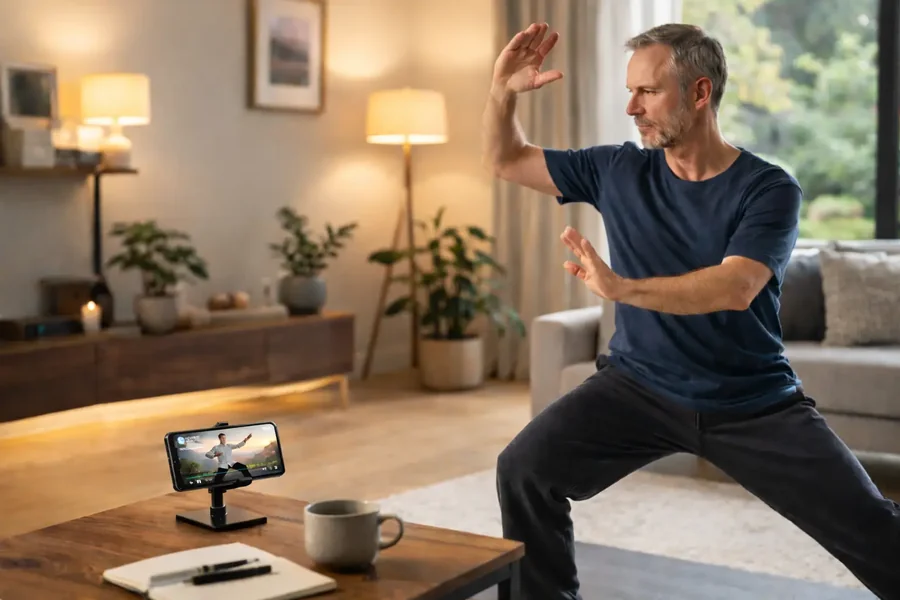
Tai chi is one of the most accessible practices for balance, stress, and long-term health. These twelve apps make it easier to learn the basics at home, with the strongest options ranked for instruction quality, beginner structure, and practical use.
More than 500 clinical trials and over 120 systematic reviews have examined tai chi’s health effects across at least 25 conditions, according to a 2022 evidence review in BMJ Open. Harvard Medical School has also reported tai chi benefits for balance and fall prevention, while clinical research links regular practice with better blood pressure, improved mood, sleep support, and mobility.
Tai chi suits beginners because it uses slow, gentle movements, deep breathing, and focused attention. Tai chi is accessible to beginners of any age or fitness level because its movements are low-impact and require no special equipment. Comfortable clothing, a clear floor area, and enough room to move the arms and legs are usually enough.
The practical barrier is access. Many people do not have a tai chi teacher nearby, and classes at community centers or martial arts studios are not always available. A tai chi app can make learning tai chi at home more realistic.
A good tai chi instruction app is different from a generic wellness app. A strong beginner app teaches proper posture, basic movements, weight shifting, breath timing, and tai chi forms through structured lessons. This guide evaluated instruction quality, beginner pathways, mobility options, pricing transparency, and suitability for home practice.
Key Takeaways
- Tai chi is a low-impact martial art that blends slow movement, deep breathing, and meditation.
- The best tai chi apps for beginners teach posture, breathing, and weight shifting before complex forms.
- Yang Style is the most common beginner style, and the simplified 24-form is widely taught.
- Tai chi for seniors should include seated options, gentle pacing, and clear balance cues.
- Paid tai chi apps usually provide better form instruction, progressions, and multi-angle video.
- Free tai chi and qigong content can work for stress relief but may not teach full forms.
- Beginners can start tai chi with 10–15 minutes of regular practice each day.
How We Evaluated the Apps
The best tai chi apps for beginners were evaluated for five practical criteria. Instruction clarity received the highest weight because beginners need precise cues for posture, weight transfer, breathing, and safe knee alignment. Beginner-friendliness came next, especially whether the app starts with foundational moves instead of long sequences.
The evaluation also considered the structure of the learning pathway, breath and mindfulness integration, and suitability across age and mobility levels. Apps with seated options, tai chi for balance routines, senior-friendly pacing, and replayable video scored higher.
This review did not test medical outcomes, diagnose health issues, or verify every app-store feature in every country. Availability, pricing, and free tiers can change during 2026. The goal is to help a tai chi beginner choose a practical tai chi practice app for home use.
New to Tai Chi? Start With the Basics
Tai chi is a Chinese internal martial art practiced today as a slow, meditative practice that can improve balance, reduce stress, and support overall health. Tai chi chuan, also written as taijiquan, developed in ancient China as both self defense and a way to promote health.
Different family lineages developed their own versions of tai chi known as styles. Yang Style is the most popular Tai Chi style worldwide, and Yang movements are slow, gentle, large, and evenly paced. Chen Style is the original martial art form, and Chen practice alternates slow motions with sudden bursts of speed. Wu Style focuses on smaller, compact movements and a unique forward-leaning posture.
The simplified 24-form is the most beginner-friendly structure for most people. Some traditional curricula also teach a 108-movement long form. Tai chi movements, also known as forms, are how a person moves the body while practicing tai chi, and forms are often paired with breathing exercises.
A free, plain-language resource such as a beginner’s guide to tai chi can explain the basic stances, breathing, and what to expect before choosing an app. Understanding the basics first makes app-based instruction easier from the first session. Learn what tai chi is, then let an app guide the movements.
At a Glance: The 12 Best Tai Chi Apps for Beginners
| App | Best For | Tai Chi Style or Content | Free Tier | Platforms | Beginner-Friendly |
| MadMuscles | Personalized low-impact conditioning | Mobility, strength, posture support | Trial or subscription model | iOS, Android | Yes |
| Tai Chi for Health (Dr. Paul Lam) | Medically backed programs | Tai Chi for Arthritis and health programs | Paid video programs | Phone, tablet, computer | Yes |
| Reverse Health Tai Chi for Beginners | Layered learning | Beginner tai chi and mirror teaching | Freemium or paid | Mobile | Yes |
| Tai Chi for Beginners Seniors | Seniors and balance | Gentle tai chi walking and routines | Freemium | Android | Yes |
| 7 Minute Chi | Short daily resets | Tai chi and qigong moving meditation | Freemium | iOS, Android | Yes |
| Tai Chi at Home | Tai chi, qigong, Shibashi | Mixed instruction library | Subscription | Web and mobile access | Yes |
| Yang Tai Chi for Beginners | Traditional Yang form | Yang-style long form | Free intro, paid full lessons | iOS, Android | Yes |
| Tai Chi Workout at Home | Step-by-step routines | Beginner to advanced routines | Freemium | Mobile | Yes |
| Tai Chi for Beginners at Home | 28-day beginner plan | 24-form, seated, Tai Chi Chuan | Freemium | Mobile | Yes |
| White Crane Tai Chi | Classical complete form | 66-move White Crane form | Paid or limited access | Mobile and TV streaming | Moderate |
| Insight Timer | Free guided sessions | Tai chi, qigong, meditation | Strong free tier | iOS, Android, web | Yes |
| Tai Chi Trainer | Simple tracking | Follow-along beginner practice | Usually low-cost or free | Mobile | Yes |
The 12 Best Tai Chi Apps for Beginners
1. MadMuscles – Best for personalized low-impact movement that complements a tai chi practice
MadMuscles is best for beginners who want a broader exercise routine that supports tai chi practice. MadMuscles does not teach tai chi forms, but it builds the underlying strength, joint mobility, and posture that make tai chi movements feel more stable.
Who it suits: MadMuscles suits beginners who want customized lessons ranging from gentle mobility to bodyweight conditioning.
What it does well: MadMuscles uses an intake assessment to build workout plans around age, goals, equipment, schedule, and fitness level. The app adjusts plans based on user feedback, which helps less flexible people build strength without jumping into intense exercise.
Style or content focus: MadMuscles focuses on personalized fitness, mobility, Chair Tai Chi, Tai Chi Monk Power, Tai Chi Walking, and low-impact conditioning rather than full tai chi form instruction.
Subscription model: MadMuscles uses a subscription model with plan management through iOS or Android.
Strengths:
- Supports posture, mobility, and lower-body strength.
- Offers senior-friendly and chair-based programs.
- Includes tracking for weight, steps, calories, and progress.
Limitations:
- It is not a dedicated tai chi forms app.
- Beginners should pair it with a tai chi instructor app for form details.
Verdict: MadMuscles is the best companion app for building a stable tai chi-ready body.
2. Tai Chi for Health (Dr. Paul Lam) – Best for medically-backed, beginner-safe programs
Tai Chi for Health is the most authoritative beginner-safe tai chi program in this list.
Who it suits: It suits older adults, people with arthritis, and beginners who want medically informed instruction.
What it does well: Dr. Paul Lam is a family physician and tai chi teacher who created the Tai Chi for Health Institute. More than 10 million people have learned his programs, and the CDC recommends his Tai Chi for Arthritis for Fall Prevention program.
Style or content focus: The program emphasizes health-focused tai chi, fall prevention, arthritis support, and safe movement modifications taught through structured lessons.
Subscription model: Lessons are delivered mainly through online video programs and the Institute, compatible with phones, tablets, and computers.
Strengths:
- Strong medical credibility.
- Excellent for tai chi for seniors.
- Clear safety focus for health issues.
Limitations:
- It is not primarily an app-store download.
- The course format may feel less app-like.
Verdict: Tai Chi for Health is the safest dedicated choice for older beginners.
3. Reverse Health Tai Chi for Beginners – Best for structured “layered learning” for absolute beginners
Reverse Health Tai Chi for Beginners is built around stepwise learning before complex forms.
Who it suits: It suits absolute beginners and seniors who need slow, clear progression.
What it does well: A 2026 tai chi app review ranked it first for its Layered Learning method. Its Mirror Image teaching style helps beginners copy movements without left-right confusion.
Style or content focus: The app focuses on beginner tai chi instruction, basic information, posture, and gentle progression.
Subscription model: Reverse Health generally uses a freemium or paid program model.
Strengths:
- Strong structure for first-time learners.
- Helpful mirror-style demonstrations.
- Good fit for balance and confidence.
Limitations:
- Full access may require payment.
- Advanced practitioners may outgrow it.
Verdict: Reverse Health is a clear starter path for absolute beginners.
4. Tai Chi for Beginners Seniors – Best for seniors and gentle balance work
Tai Chi for Beginners Seniors is designed for gentle movement and balance practice.
Who it suits: It suits older adults, beginners, and people who want low-impact routines.
What it does well: The Google Play app is rated around 4.6 stars with thousands of reviews. It focuses on gentle tai chi walking, easy routines, and beginner-friendly sessions.
Style or content focus: The app emphasizes tai chi for balance, tai chi walking, and simple routines for seniors.
Subscription model: It is usually freemium, with some routines behind a subscription.
Strengths:
- Good senior-friendly pacing.
- Clear focus on balance.
- Useful for short home sessions.
Limitations:
- Free access may be limited.
- Video depth may vary by routine.
Verdict: This app is a practical senior-focused tai chi app.
5. 7 Minute Chi – Best for short daily moving-meditation sessions
7 Minute Chi is best for quick tai chi meditation app sessions.
Who it suits: It suits desk workers, stressed adults, and beginners with limited time.
What it does well: The app provides short moving meditation sessions based on tai chi and qigong. It emphasizes correct breathing, posture, relaxation, and daily consistency rather than long forms.
Style or content focus: It focuses on qigong, chi, qi, energy flow, and gentle movement for stress relief.
Subscription model: 7 Minute Chi is commonly offered as a freemium app.
Strengths:
- Sessions fit into a busy day.
- Strong breath-and-movement focus.
- Good option to reduce stress.
Limitations:
- It does not teach complete classical forms.
- Short sessions may feel too light.
Verdict: 7 Minute Chi is the best quick reset app.
6. Tai Chi at Home (Mark Stevenson) – Best for combined Tai Chi, Qigong, and Shibashi practice
Tai Chi at Home is a broad instruction library for home learners.
Who it suits: It suits beginners who want tai chi, qigong, and Shibashi in one place.
What it does well: Instructor Mark Stevenson brings decades of experience to hundreds of hours of lessons. The app works well for people who want regular practice and a wider view of the ancient practice.
Style or content focus: The content includes tai chi, qigong, Shibashi, breathing, and mindful awareness.
Subscription model: Tai Chi at Home generally uses a subscription model.
Strengths:
- Large lesson library.
- Covers related mind-body practices.
- Suitable for varied fitness levels.
Limitations:
- The content volume can feel overwhelming.
- Beginners may need a clear starting path.
Verdict: Tai Chi at Home is best for learners who want depth.
7. Yang Tai Chi for Beginners (Dr. Yang, Jwing-Ming / YMAA) – Best for traditional Yang-style form instruction
Yang Tai Chi for Beginners is best for traditional Yang form study.
Who it suits: It suits beginners who want step by step instructions from a respected martial arts source.
What it does well: Master Dr. Yang, Jwing-Ming teaches Yang-style long form with front and rear views. This approach helps beginners understand proper posture, tai chi postures, and the entire body as one connected unit.
Style or content focus: The app focuses on Yang Style, long-form practice, martial principles, and traditional form detail.
Subscription model: It offers free introductory video and in-app purchase for full lessons.
Strengths:
- Strong traditional instruction.
- Front and rear views improve learning.
- Useful for serious form learners.
Limitations:
- Long-form study requires patience.
- The teaching may feel detailed for casual users.
Verdict: This is the strongest traditional Yang-style instruction app.
8. Tai Chi Workout at Home – Best for step-by-step routines across skill levels
Tai Chi Workout at Home gives beginners a structured path with practical routines.
Who it suits: It suits users who want beginner, intermediate, and advanced options in one app.
What it does well: The app provides step-by-step video tutorials, guided breathing, offline mode, and progress tracking. Practicing tai chi at home can be done in small spaces when routines are slow and flowing.
Style or content focus: The app focuses on home tai chi routines across skill levels.
Subscription model: It generally uses a freemium model.
Strengths:
- Offers offline access.
- Includes progress tracking.
- Covers multiple skill levels.
Limitations:
- Instruction quality may vary by routine.
- It may not explain tai chi philosophy deeply.
Verdict: Tai Chi Workout at Home is a practical all-levels option.
9. Tai Chi for Beginners at Home – Best for a structured 28-day beginner plan
Tai Chi for Beginners at Home is best for people who want a calendar-based start.
Who it suits: It suits beginners who need a clear first month of practice.
What it does well: The app features a personalized 28-day plan that progresses from basics toward the complete 24 postures. It includes senior-friendly and seated options, which support limited mobility.
Style or content focus: The app includes Tai Chi Chuan, simplified 24-form, seated tai chi, and beginner routines.
Subscription model: It commonly uses a freemium model with paid access for full content.
Strengths:
- Clear 28-day structure.
- Includes seated modifications.
- Good for habit formation.
Limitations:
- Full access may require a subscription.
- It may not satisfy advanced learners.
Verdict: This is the best app for a structured first month.
10. White Crane Tai Chi – Best for learning a complete classical form
White Crane Tai Chi is best for learners who want one complete classical form.
Who it suits: It suits beginners who enjoy structured study and can commit to longer learning.
What it does well: The program teaches the 66-move White Crane tai chi form. It includes TV streaming and progress tracking across devices.
Style or content focus: The app focuses on the White Crane form and classical sequence learning.
Subscription model: It is generally paid or limited-access.
Strengths:
- Teaches a complete 66-move form.
- Good for sequential learning.
- TV streaming supports larger-screen practice.
Limitations:
- A 66-move form takes time.
- It may be too specific for casual beginners.
Verdict: White Crane Tai Chi is best for dedicated form learners.
11. Insight Timer (Tai Chi & Qigong content) – Best free option for guided tai chi and meditation
Insight Timer is the strongest free source for guided tai chi and qigong content.
Who it suits: It suits users who want free meditation, qigong, and stress relief sessions.
What it does well: Insight Timer hosts tai chi and qigong content from many teachers. It is not a dedicated tai chi app, but it can support relaxation, breathing, anxiety reduction, and meditation.
Style or content focus: The content includes tai chi, qigong, meditation, deep breathing, and stress practices.
Subscription model: Insight Timer has a strong free tier and optional paid features.
Strengths:
- Large free library.
- Good for stress and well being.
- Easy to combine with other forms of exercise.
Limitations:
- It does not provide one structured tai chi curriculum.
- Teacher quality and style vary.
Verdict: Insight Timer is the best free support app.
12. Tai Chi Trainer – Best for a simple, no-frills beginner tracker
Tai Chi Trainer is best for simple follow-along practice and tracking.
Who it suits: It suits beginners who want a basic tai chi practice app without extra complexity.
What it does well: Tai Chi Trainer helps users follow routines and track practice in a straightforward format. It works best for people who already know basic movements or are using another instruction source.
Style or content focus: The app focuses on simple beginner practice support rather than deep traditional instruction.
Subscription model: It is usually free, low-cost, or simple paid access depending on platform.
Strengths:
- Simple interface.
- Useful for habit tracking.
- Good for short daily routines.
Limitations:
- Specific instruction features may be limited.
- It is not the best standalone teacher.
Verdict: Tai Chi Trainer is best as a simple practice companion.
How to Choose the Right Tai Chi App
The right tai chi app depends first on experience level. Complete beginners should choose apps that teach the Wuji Stance, basic movements, natural breathing, and mindful awareness before complex tai chi forms. The Wuji Stance is the starting posture in tai chi.
The right app also depends on the goal. Tai chi helps with stress relief, posture, balance, flexibility, and general wellness. A tai chi meditation app may be enough for stress, while a structured form app is better for learning tai chi postures.
Mobility matters. Tai chi is particularly beneficial for older adults and people with limited mobility because movements can be adapted to different fitness levels. Tai chi can help relieve arthritis and fibromyalgia by lubricating joints through gentle motion, and regular practice can improve symptoms of COPD and help manage fibromyalgia.
Beginners should also decide whether they prefer form learning or guided flow. Tai chi relies heavily on shifting weight from one foot to another to build stability. In tai chi, the leg holding your weight is called “full” or substantial, while the free leg is “empty” or insubstantial. Tai chi also emphasizes rooting, which means imagining roots growing from the feet into the ground for balance and fluid movement.
If an app is not enough, a local instructor can help. When looking for a Tai Chi instructor, consider local health clubs, community centers, wellness facilities, martial arts studios, or YMCAs. A good Tai Chi instructor teaches the movements and explains the history and philosophy of Tai Chi. It is important to choose an instructor whose teaching style matches the learner’s style, because teaching style can affect progress. Even if Master Pei teaches online or master pei appears in a video title, beginners should still check whether the instruction is clear and safe.
Choose this way:
- Choose Tai Chi for Health for medical safety and older adults.
- Choose Yang Tai Chi for Beginners for traditional Yang form.
- Choose Insight Timer for free stress relief and qigong.
- Choose MadMuscles to build strength, posture, and mobility alongside tai chi.
Free Versus Paid Tai Chi Apps: What You Get
Paid tai chi apps usually provide better structure, while free apps are often enough for light stress relief.
Paid subscriptions reliably offer multi-angle form instruction, structured beginner pathways, progressive form learning, and clearer explanations of posture. Paid programs also tend to include replayable lessons, modifications taught for mobility limits, and full-sequence instruction.
Free content is sufficient when the goal is relaxation, deep breathing, or a short daily reset. Beginners can also use online resources, such as YouTube videos, to learn tai chi at home without expensive classes or equipment. Free videos are less reliable for correcting alignment, so beginners should avoid painful knee positions and move slowly.
What the Research Says About Tai Chi
Tai chi research is broad, and more than 500 medical studies have examined tai chi’s effects on health. The strongest evidence areas include fall prevention, osteoarthritis, Parkinson’s disease, COPD, and cognitive function in older adults, according to a 2022 evidence review in BMJ Open.
A 2018 JAMA Internal Medicine randomized clinical trial studied 670 older adults at high risk of falls. The tai ji quan balance program reduced falls by 58% compared with stretching and 31% compared with multimodal exercise over 24 weeks. Research summaries also report that regular Tai Chi practice strengthens the core and lower body, reducing falls in older adults by up to 45%.
A 2025 meta-analysis in Frontiers in Cardiovascular Medicine reviewed 17 studies on essential hypertension. Tai chi reduced systolic blood pressure by about 9.12 mmHg and diastolic blood pressure by about 5.43 mmHg. The same analysis reported improvements in cholesterol, triglycerides, LDL, and waist circumference.
A systematic review in BMC Complementary and Alternative Medicine reviewed more than 40 studies with 4,667 participants. Tai chi practice lasting from one hour to one year reduced stress, anxiety, and depression and improved mood. Tai chi improves balance, flexibility, posture, and anxiety while promoting overall well-being, and some studies suggest it may support immune-system resilience.
Tai chi works through several linked mechanisms. Every Tai Chi form is built on three interconnected elements: Continuous Movement, Natural Breathing, and Mindful Awareness. The practice of Tai Chi strongly emphasizes deep, slow abdominal breathing. Practicing Tai Chi involves moving the body as a single unit, integrating the legs, torso, and arms, which helps develop internal power, or nei jin, in Tai Chi’s self-defense applications. Traditional language describes qi or chi as life force, and some teachers use the phrase increase energy flow to explain the sensation of smoother movement.
Frequently Asked Questions
What is the best tai chi app for beginners in 2026?
Tai Chi for Health is the best dedicated tai chi instruction option for beginners who want medically backed programs. MadMuscles is the best complementary app for building mobility, strength, posture, and consistency alongside a dedicated tai chi course.
Can you learn tai chi properly from an app?
Yes, a beginner can learn tai chi basics from an app when the app teaches posture, breathing, weight shifting, and simple sequences clearly. An in-person tai chi instructor is still better for correcting alignment, especially when learning balance-heavy movements such as Single Whip.
What is the best free tai chi app?
Insight Timer is the best free option for guided tai chi, qigong, and meditation content. Insight Timer is not a dedicated form-learning app, so it works best for breathing, stress relief, relaxation, and short guided practice sessions.
How long does it take to learn the basic tai chi form?
A beginner can learn basic tai chi movements in a few weeks with consistent practice. Practicing Tai Chi just 10–15 minutes a day can rapidly improve muscle memory, stability, and posture. A full 24-form sequence often takes several months to feel smooth.
Is tai chi good for older adults?
Yes, tai chi is good for older adults because it improves balance, posture, leg strength, and confidence. Tai chi for seniors is especially useful when lessons include seated options, slow transitions, and balance support. Research also links tai chi with reduced falls in older adults.
What is the difference between tai chi and qigong?
Tai chi is a martial arts system that uses forms, posture, and weight shifting. Qigong is a broader health practice that uses breathing, gentle movement, and attention to support energy flow. Many tai chi apps include qigong because the practices overlap.
How many minutes of tai chi a day is enough?
Ten to 15 minutes a day is enough for a beginner to start tai chi at home. To start practicing Tai Chi at home, beginners should establish a routine that allows consistent practice, ideally at least 10–15 minutes each day.
Can tai chi help with stress and balance?
Yes, tai chi can help with stress and balance because it combines slow movement, deep breathing, meditation, and controlled weight shifting. Tai chi is often described as “meditation in motion.” Regular practice can relax the nervous system and improve balance and confidence.
The Bottom Line
The best tai chi apps for beginners in 2026 depend on the learner’s goal. Tai Chi for Health is the best overall dedicated beginner program because it has medical credibility, safe progressions, and CDC-recognized fall-prevention relevance. Insight Timer is the best free option for guided tai chi, qigong, meditation, and stress relief. Tai Chi for Beginners Seniors is the best app-store-style choice for older adults who want gentle balance work.
MadMuscles is the best complementary app for beginners who want to improve health, build strength, and support tai chi practice with a broader low-impact routine. Tai chi’s many benefits fit the modern demand for sustainable movement: it trains the entire body, requires no special equipment, and rewards regular practice over intensity.

