
Selling used or refurbished items on Amazon is a different game from selling new. Your competitors are not the sellers offering the same item brand new in a sealed box. They are the sellers in the same condition tier as you, fighting for the same buyer who has already decided they want a pre-owned product and is now choosing between your listing and five others.
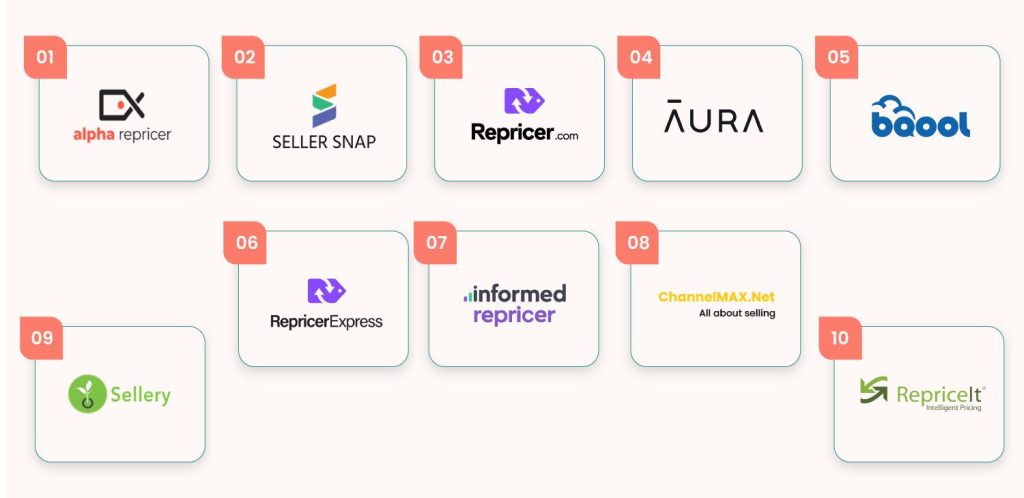
Most repricer articles are written with new goods sellers in mind. Used sellers read them and feel like the advice does not quite apply, because it usually does not. The core requirement for a used goods repricer is condition-based filtering, and not every tool handles it well. Below are ten repricing tools worth considering for used and refurbished goods sellers in 2026.
1. Alpha Repricer
Alpha Repricer condition filter is one of the most granular on this list. You can choose to compete against the same condition only, same or better, refurbished only, or specific used sub-conditions. That last point matters because Used Like New and Used Acceptable are not the same market, and pricing as if they are will either cost you the Buy Box or eat your margin.
The formula-based min/max system calculates your floor from acquisition cost, item shipping, and Amazon fees rather than a fixed number you set once. For used sellers where acquisition cost varies per unit, this is how pricing should work. The Buy Box Hunter algorithm then operates within those boundaries to win placement without dropping below your margin threshold. Yo-Yo Repricing automatically nudges your price upward when you are already winning, recovering margin instead of sitting at the floor indefinitely.
It covers 23 Amazon marketplaces, supports B2B repricing, includes FTP feed integration for inventory updates, and provides a full analytics dashboard.
Best for: Used and refurbished sellers who need precise condition-based filtering and cost-aware margin protection.
2. Seller Snap
Seller Snap uses game theory AI to avoid price wars rather than simply reacting to competitor moves. In used goods categories where margins are already thin, this approach protects against the kind of downward spiral that makes individual units unprofitable.
It supports Amazon and Walmart with deep ASIN-level analytics. Seller Snap is positioned toward the premium end of the repricing market, making it more suitable for established sellers with larger catalogs.
Best for: High-volume used goods sellers focused on margin defense.
3. Repricer.com
Repricer.com responds not just to price changes but to condition changes among your competitors. When a competitor shifts their condition grade, the tool receives that signal and adjusts accordingly, which is directly relevant for used sellers where condition shifts change your competitive position.
It covers multiple Amazon marketplaces globally and reacts quickly to marketplace changes. The platform’s multi-marketplace coverage makes it a strong choice for sellers operating across Amazon and other channels simultaneously.
Best for: Used goods sellers who operate across multiple marketplaces and need condition-aware repricing.
4. Aura
Aura brings AI and game theory repricing to sellers looking for more automation. It covers Amazon and Walmart, and includes features designed to prioritize updates on important listings in competitive categories.
The AI adapts to marketplace conditions and seller data over time, helping refine pricing decisions based on actual competitive behavior.
Best for: Used goods sellers who want AI-driven repricing with advanced automation.
5. BQool Repricing Central
BQool explicitly supports used and refurbished product repricing, a feature some tools overlook entirely. The hybrid approach lets you run AI-powered or rule-based strategies depending on the product, which is useful for mixed catalogs where different condition tiers warrant different approaches.
The dashboard includes repricing reports, Buy Box tracking, and KPI monitoring across multiple Amazon marketplaces.
Best for: Mixed-catalog sellers who want flexibility between AI and rule-based strategies.
6. RepricerExpress
RepricerExpress covers both Amazon and eBay, which matters for used goods sellers since eBay is a primary channel for pre-owned inventory. Competitor filtering covers fulfillment type, seller rating, feedback score, and shipping location.
Automation triggers can shift repricing strategies based on stock levels and sales performance. For sellers working with limited quantities of used inventory, this can help adapt pricing as inventory changes.
Best for: Used goods sellers who also sell on eBay and want consolidated repricing.
7. Informed Repricer
Informed Repricer has been established in the repricing market for many years and uses a usage-based pricing model rather than a strictly SKU-based approach.
The platform surfaces margin data and sales velocity at the listing level, helping sellers make more informed pricing decisions based on actual performance metrics rather than assumptions.
Best for: Data-focused used goods sellers with large or varied catalogs.
8. ChannelMax
ChannelMax supports Amazon and eBay and allows sellers to set different repricing strategies per condition tier. It is a rule-based tool without an AI layer, which suits sellers who prefer direct control over their pricing logic rather than delegating decisions to an algorithm.
Best for: Used goods sellers who want straightforward condition-specific rules.
9. Sellery by SellerEngine
Sellery uses algorithmic repricing and supports used and refurbished listings with condition-level rule setting. The platform uses a pricing model that can scale with seller performance rather than relying solely on catalog size.
For sellers with large catalogs of lower-value items, this approach may offer more flexibility than some traditional pricing structures.
Best for: Used goods sellers who prefer a revenue-scaled pricing model.
10. RepriceIt
RepriceIt is one of the more accessible entry-level repricing tools available. It is rule-based and supports condition-aware repricing for sellers who want to automate pricing without adopting a more advanced AI-driven platform.
While it lacks many of the advanced features found in enterprise tools, it remains a practical starting point for sellers looking to move beyond manual pricing.
Best for: New used goods sellers who want basic repricing at minimal cost.
What Used Sellers Should Actually Look for
Condition filtering is the starting point. Your repricer must keep you competing within your tier, not against the full used pool or, worse, against new listings. Sub-condition granularity matters too since Used Like New and Used Acceptable serve different buyers at different price points.
Per-unit cost tracking is the second requirement. Used acquisition costs vary per unit. A formula-based floor that calculates from actual cost outperforms any flat minimum price applied uniformly across inventory. Finally, look for stock-level logic. When you are down to one unit, your strategy should shift automatically rather than continuing to race downward.
The right repricer for used goods sellers is one that understands condition as a core variable, not an afterthought. Amazon’s official condition guidelines explain how items must be categorized across condition tiers, making accurate condition-based repricing essential for used and refurbished inventory. See Amazon Seller Central’s Condition Guidelines.
Final Word
Used and refurbished selling on Amazon rewards sellers who price with precision. The used Buy Box is its own competition, separate from new listings, and winning it consistently requires a repricer that treats condition as a core variable rather than an afterthought.
The right tool depends on your catalog size, budget, and whether you sell across multiple platforms. But regardless of which repricer you choose, the starting point is always the same: set your floor per unit based on actual acquisition cost, apply your condition filters before you reprice a single listing, and revisit both whenever your sourcing costs change. A repricer that does not understand condition is not built for this seller type, and the difference shows up quickly in your margins.

