
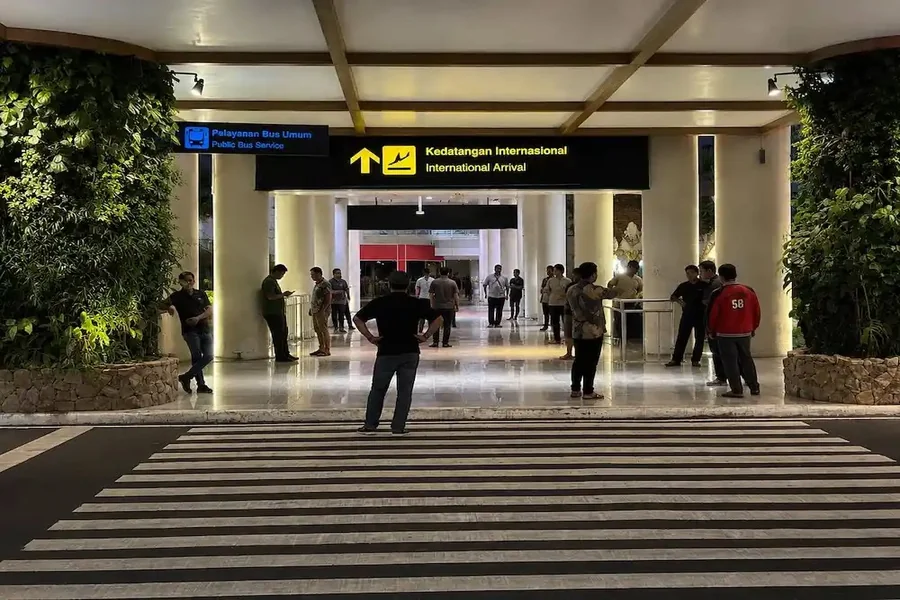
Ngurah Rai International handles the overwhelming majority of arrivals to Bali, and the first real decision every visitor makes on the island happens in its arrivals hall: how to reach the accommodation. The options range from a fixed-price taxi counter to ride-hailing apps, private transfers, and scooter delivery directly to the terminal. The right choice depends almost entirely on three variables — how much luggage is in tow, how far the accommodation sits from the airport, and how long the overall stay will last.
The official taxi counter is the frictionless option. Prices are posted inside the arrivals hall and are non-negotiable, though noticeably higher than the alternatives. Grab and Gojek both operate at the airport but cannot collect passengers directly outside arrivals; pickups happen from a designated zone that the app specifies, and following that instruction precisely is the difference between a short wait and a long, confused one. Fares typically run well below the taxi counter for an identical journey, which is why the ride-hailing route dominates among solo travellers with a single transfer to make.
For visitors staying two weeks or more with light luggage, a bali airport scooter rental solves the transport question for the entire trip in one move. The bike is delivered to the terminal, the paperwork is handled on arrival, and the rider leaves on the same vehicle they will use for the rest of the stay, rather than sourcing one from a roadside stall two days later. This approach only makes sense under specific conditions: a backpack rather than two suitcases, a motorcycle-endorsed licence already in hand, and an arrival time that is not the middle of the night after a long-haul flight.
Journey times matter more than distance
Bali’s traffic makes distance a poor predictor of time. Kuta is fifteen minutes away in light conditions and closer to forty in the evening crush. Canggu can take an hour and a half by car on a Friday evening — and roughly half that on two wheels, which is the structural reason scooters remain the island’s default mode of transport rather than a novelty for the adventurous.
| Destination | Typical | Rush hour |
|---|---|---|
| Kuta | 15 min | 40 min |
| Seminyak | 30 min | 60 min |
| Canggu | 50 min | 90 min+ |
| Ubud | 80 min | 2 hours |
| Sanur | 30 min | 60 min |
The sensible sequence
Arriving late with heavy luggage calls for a car; the scooter can be arranged for the following morning, and most providers deliver to hotels as readily as to the terminal. Whichever mode a rider chooses, the legal essentials are the same. A helmet is mandatory, an International Driving Permit endorsed for category A is required to ride legally, and a car-only permit will not cover a scooter. Checkpoints around Denpasar and along Sunset Road check licence, helmet, and the vehicle registration document as routine, so having all three in order before leaving the airport is simply the efficient way to start a trip.

