
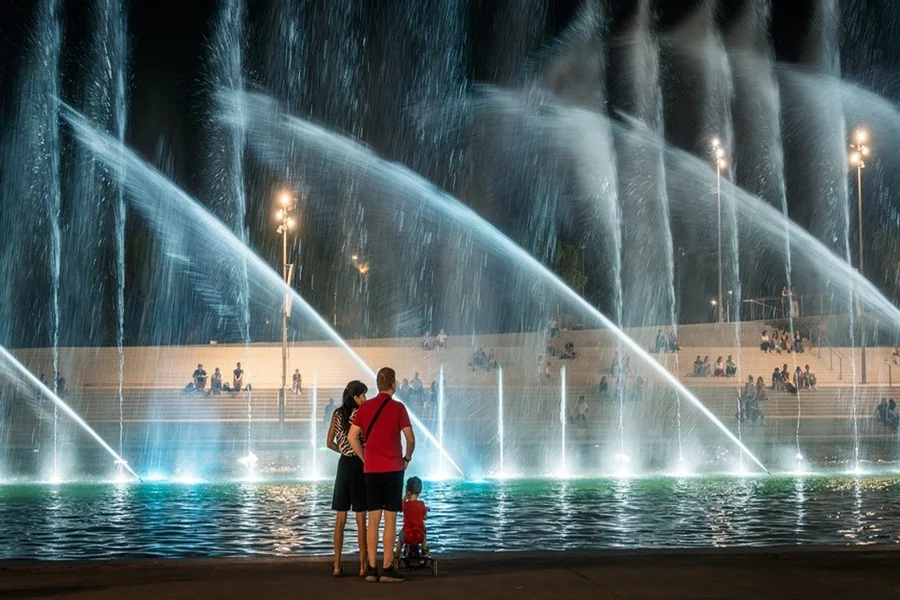
A dancing fountain show is a live aquatic performance where programmed water jets, music, lighting and sometimes video effects are synchronized to create an immersive spectacle. The result can feel simple to the audience, but the technology behind it is a precise combination of hydraulics, show control, scenography and safety engineering.
As an aquatic show consultant working on event projects and permanent installations, I see this type of production as more than decorative water effects. A successful dancing fountain show must be readable from a distance, emotionally connected to the soundtrack and technically reliable in changing outdoor conditions.
How a dancing fountain show works
The core principle is synchronization. A central control system sends time-coded instructions to pumps, valves, lights and audio equipment. Each water movement is programmed to match musical accents, rhythm changes or dramatic pauses.
Water jets can rise vertically, sweep sideways, pulse rapidly or create fan shapes. Variable-speed pumps adjust height and pressure, while fast-response valves create sharp movements. LED projectors add color, depth and contrast, making the water visible at night and more expressive during the performance.
In practice, the most effective sequences are not always the most powerful. During the analysis of large public shows, I have often observed that a lower jet, perfectly timed with a musical break, creates more impact than a high jet used continuously. The learning is clear: choreography matters as much as equipment capacity.
Main technical components
| Component | Role in the show | What it changes for the audience |
| Pumps and valves | Control water height, rhythm and movement | Create dynamic effects, pulses and crescendos |
| Show control software | Synchronizes water, music and lights | Makes the performance feel intentional and fluid |
| LED lighting | Adds color and visual contrast | Enhances emotion, visibility and atmosphere |
| Audio system | Delivers the soundtrack clearly | Supports timing and audience immersion |
| Basin or water system | Collects, filters and recirculates water | Keeps the installation stable and sustainable |
| Safety controls | Manage wind, pressure and public distance | Reduce operational risk |
Why music changes the perception of water
Music gives structure to the visual sequence. A slow orchestral piece may call for wide, elegant water movements. A pop or electronic track usually needs shorter pulses, sharper transitions and stronger lighting contrasts.
The key is not to animate every beat. Professional programming often leaves visual space between effects so the audience can anticipate the next movement. This restraint helps avoid visual fatigue, especially in shows lasting more than five minutes.
The role of light in immersive entertainment
Light transforms water into a visible medium. Without lighting, many effects lose detail after sunset. With lighting, each jet becomes a moving surface that can reflect color, create volume and guide attention.
However, lighting must be adapted to the site. A seaside event, an urban square and a theme park do not have the same ambient light, viewing angles or technical constraints. This is where the design process becomes site-specific rather than purely technical.
A field example and a human perspective
On the ground, wind is one of the most underestimated factors. Even a well-programmed show can lose clarity if fine water effects drift toward the audience or outside the basin. For exposed outdoor venues, I usually recommend fewer mist effects and stronger, more stable jets.
Claire, event production manager for a city summer festival, experienced this during an outdoor evening show. “The first rehearsal looked too delicate because of the wind,” she explained. “After adjusting the water heights and simplifying two sequences, the audience response was much stronger, and we avoided water spray near the front rows.” Her feedback highlights a practical point: reliability often improves the artistic result.
Limits and conditions to consider
A dancing fountain installation depends on space, water access, drainage, wind exposure, electrical capacity and local safety rules. Temporary event systems are faster to deploy but may offer less architectural integration. Permanent installations allow deeper design work but require maintenance planning, filtration and seasonal operation procedures.
Technical standards and safety practices matter because they define distances, electrical protection and public access conditions. In concrete terms, they are not administrative details; they influence the size of the basin, the placement of equipment and the acceptable height of water effects.
What is a dancing fountain show?
A dancing fountain show is a synchronized performance using water jets, music and lighting. The water appears to “dance” because pumps, valves and lights are programmed to follow a musical timeline.
How long does a fountain show usually last?
Most public shows last between 3 and 12 minutes. Shorter formats work well for repeated performances, while longer shows need stronger storytelling to keep attention.
Can a dancing fountain show be installed temporarily?
Yes, temporary systems can be used for festivals, ceremonies, brand events or cultural programs. The feasibility depends on site access, water management, electrical supply and audience safety.
What makes a water show feel immersive?
Immersion comes from precise synchronization, strong sound design, controlled lighting and clear viewing angles. The audience should understand the rhythm visually, not only hear it in the music.
A well-designed aquatic performance is a balance between creative ambition and technical discipline. The best results come from choosing effects that fit the site, the soundtrack and the audience, rather than simply using the highest jets or the brightest lights.

