
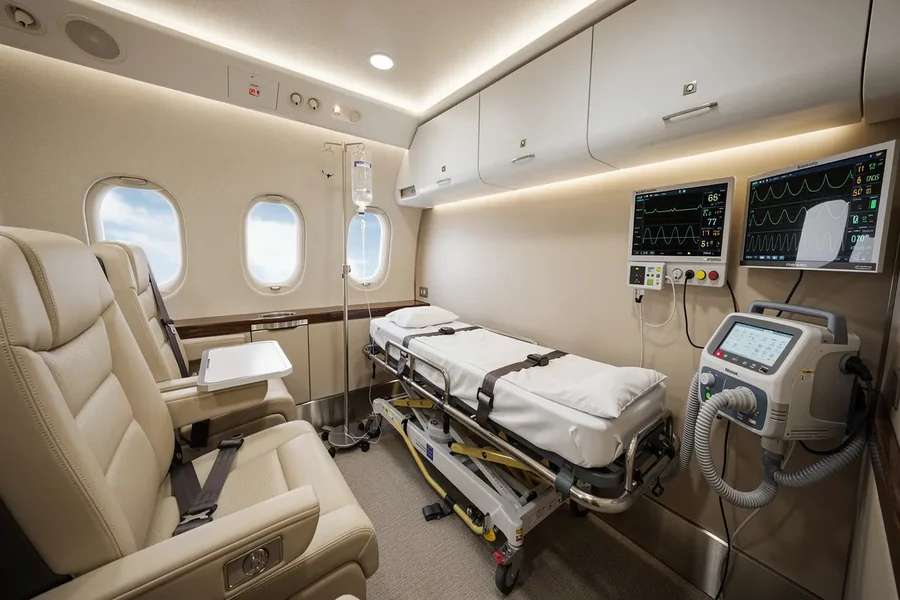
A long-distance medical journey may involve a dedicated aircraft or a seat on a scheduled airline. Both can be described as a medical flight, but they are not interchangeable. The useful starting point is what the patient can manage during travel, what support the treating team considers necessary, and how the journey will work from one care setting to another.
Why “medical flight” can mean different things
The term covers several arrangements. A private air ambulance uses a dedicated aircraft for the patient’s transport. A commercial airline stretcher places a patient who needs to lie down aboard a scheduled flight. A medical escort accompanies a patient travelling in a regular airline seat. Each arrangement has a different relationship to the airline, the available space and the medical support provided during the journey.
That distinction matters when a family is trying to make sense of an unfamiliar situation. Someone may be ready to leave a hospital but still need help travelling a long distance. Another patient may need care throughout the flight that cannot be planned around an ordinary airline itinerary. Neither situation can be resolved by choosing the most familiar-sounding service. The treating medical team must identify the patient’s needs, while a transport provider can assess how those needs fit a proposed route and travel arrangement.
Private air ambulance: a dedicated aircraft and linked ground transfers
A private air ambulance is an aircraft arranged for the medical transport rather than a seat or stretcher space on a scheduled passenger service. Its medical crew and onboard setup are planned around the patient’s needs. The flight is also only one part of the journey: bedside-to-bedside service includes ground ambulance transport at both ends and a handoff at the receiving facility. For someone comparing options, the practical question is whether the patient needs that dedicated arrangement and the level of in-flight support it can accommodate.
Advanced Air Ambulance is a Miami-based provider that has operated since 1990. Its medical flight options include private air ambulance transport as well as arrangements using scheduled airlines. The company provides domestic and international services and is licensed by the Florida Department of Health as an air ambulance provider. Those facts offer useful context, but a provider’s history or licensing does not replace a discussion of the individual patient’s care requirements.
A dedicated flight may also allow the transport plan to be built around a particular departure point, destination and receiving facility. That does not mean every requested route or departure time is available. The medical plan, aircraft arrangements and transfers on the ground all have to fit together. Families and care teams should understand which organization is responsible for each stage before treating a proposed flight as a complete door-to-door solution.
Commercial stretcher: scheduled airline travel with a stretcher
A commercial airline stretcher is different from an air ambulance even though the patient travels by air with medical personnel. The stretcher is installed aboard a scheduled airline flight, so the journey follows that airline’s route and operating arrangements. It can be an option when a patient needs to remain lying down during the flight, provided the medical team and transport provider determine that the arrangement meets the patient’s needs.
Because it uses a scheduled service, availability depends on the airline and the flight in question. Connections, airport transfers and the time spent between stages of travel can matter as much as the time in the air. A family member may be able to book a seat on the same flight, but that should be considered alongside the airline’s arrangements and the patient’s transport plan rather than assumed at the outset.
The stretcher option is not simply a private air ambulance moved into an airline cabin. The aircraft is serving other passengers, and the route is not designed solely for the patient. Asking how the patient will move between the departure facility, airport, aircraft and destination facility helps reveal whether the proposed itinerary is workable as a whole.
Medical escort: support in a regular airline seat
A medical escort travels with a patient on a commercial flight, generally when the patient can use a regular airline seat but needs professional medical accompaniment and support during the journey. The distinction from a commercial stretcher is the way the patient travels: the escort accompanies someone seated in the cabin rather than someone lying on an installed stretcher.
The role can include helping the patient navigate the travel itinerary and providing the support agreed in the transport plan. It does not turn a scheduled flight into a dedicated medical aircraft. Airport movement, connections, seating and any assistance needed before departure or after arrival still need attention. A route that looks straightforward on a booking screen may involve several demanding stages for a person recovering from illness or receiving ongoing care.
Advanced Air Ambulance arranges medical escorts alongside its air ambulance and commercial-stretcher services. Having those choices available makes it possible to discuss different ways of traveling, but the choice depends on the patient’s circumstances. Families should not infer from a patient’s ability to sit briefly that a seated journey with connections is suitable; the treating team and transport provider need to consider the full trip.
What should families and care teams compare before deciding?
A useful comparison begins with a description of the journey rather than a preference for a particular aircraft. The sending team can explain the support the patient needs during travel and any concerns about sitting, lying down or moving between vehicles. The transport provider can then consider those requirements against the available arrangements. For hospitals and case managers, the same conversation helps distinguish a clinically appropriate transfer plan from an itinerary that works only on paper.
Several practical questions can keep that conversation focused:
- How will the patient travel? Can the proposed plan accommodate the position and assistance the treating team considers necessary throughout the journey?
- What support is needed in transit? Ask who will accompany the patient, what responsibilities that person will have, and how the plan covers the time outside the aircraft.
- What does the route involve? A scheduled flight may have connections and airline requirements; a dedicated flight has its own aircraft and ground-transfer arrangements.
- Who handles each handoff? Confirm how the patient will get from the current facility to departure and from arrival to the receiving facility.
- Can relatives travel? Space on a dedicated aircraft and seats on a scheduled flight are different arrangements. Ask what is possible for the proposed journey.
- Who is providing the service? Discuss relevant licensing, crew qualifications and who will coordinate changes or questions during planning.
These questions are a starting point, not a way to assess medical fitness independently. A patient’s condition may change, and an apparently convenient itinerary may not meet the care plan. The treating team and transport provider should evaluate the particular case together before a travel arrangement is chosen.
A practical next step for planning
Before speaking with a transport provider, gather the patient’s current location, intended destination, receiving facility and expected travel timeframe. Have the treating team’s relevant medical information available through the appropriate channels. Those details help make the first conversation specific: instead of asking only whether a “medical flight” is available, a family or care coordinator can ask what form of transport is being considered and what it includes.
It is worth confirming the complete scope of the proposal, particularly medical accompaniment, airport arrangements, ground transfers and handoffs between facilities. If a commercial airline is involved, ask how its availability and itinerary affect the plan. Insurance coverage varies by policy and circumstance, so coverage questions belong with the insurer rather than being treated as settled by the choice of transport. The aim is a journey whose medical and logistical parts have both been considered before anyone commits to a route.

