ADVERTISEMENT
When a company cycles a battery several times a day to exploit price differences between peak and off-peak hours, every charge and discharge runs through electrical panels under continuous load. That load creates heat, and heat inside a panel is where fire risk starts. Much of that cycling happens at night, when nobody is on site to notice.
- Battery storage trading puts electrical panels under repeated high-load stress. Heat buildup is the primary risk factor, not the battery itself.
- An automatic fire suppression system for electrical panels can extinguish a fire inside the enclosure without any human intervention and without an external power supply.
- Certified panel production combined with built-in fire suppression reduces unplanned downtime, and logbooks and service reports document the system for insurers and authorities.
How the panels run the trading operation
Every time the market price drops below a threshold, the control system tells the battery to charge. When the price climbs during peak hours, it discharges and sells back to the grid. The physical switching, the current routing, and the monitoring of voltage and temperature all happen inside the electrical panel.
A trading battery can run several full cycles in a single day, pushing high current through busbars, breakers, contactors, and connection points continuously.
That is where thermal stress accumulates. Components warm up with every cycle and do not always cool fully between them. Over months, repeated heating and cooling loosens connections and degrades insulation. This is the kind of infrastructure SystemTeknik electrical panel production has specialised in for more than 70 years, designing panels for high-load, continuous-duty environments across green energy and industrial applications.
Three failure modes that threaten panel safety
Three fault types are worth knowing in high-cycle battery operations, and cycling frequency makes each of them more likely.
- Heat accumulation. Connections that carry high current for hours generate resistive heat. When heat cannot escape the enclosure fast enough, temperatures climb until insulation breaks down.
- Overload during peak demand. The most aggressive trading happens during price spikes, which coincides with the highest discharge rates. Components rated for normal load can be pushed beyond their margins during these windows.
- Arc faults. A loosened terminal or degraded connection can create an electrical arc. Arc temperatures reach several thousand degrees in milliseconds, igniting nearby insulation almost instantly.
The strategy that maximises margin also raises the fire probability. More cycles mean more heat, more peak-load events, and more mechanical wear on the connections that cause arc faults.
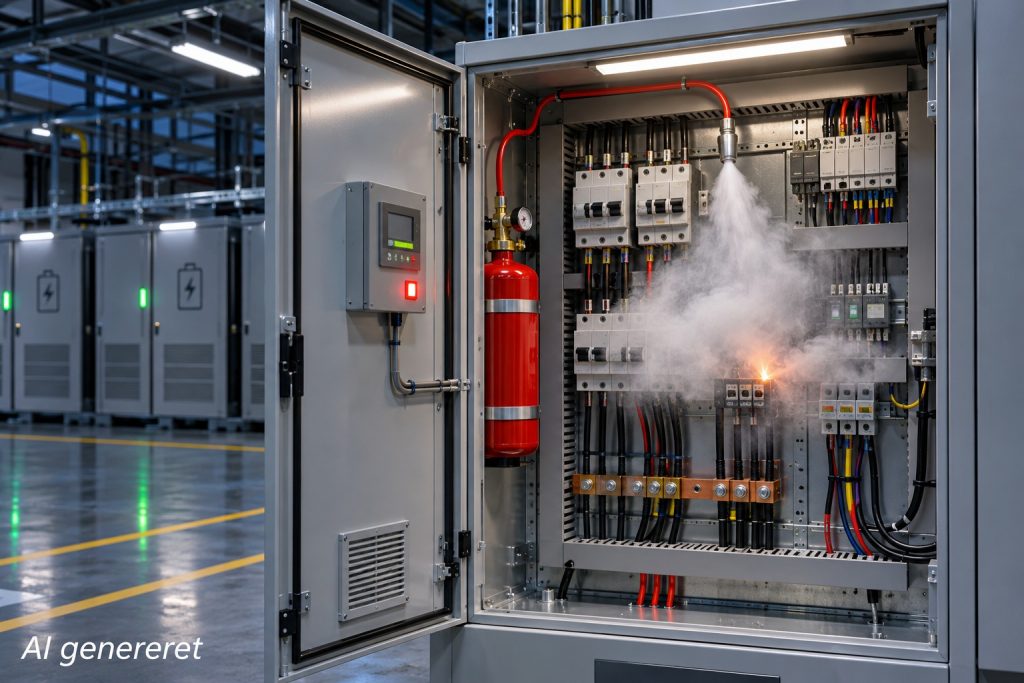
This is why an automatic fire suppression system for electrical panels matters. It sits where these faults actually start, releasing an agent directly at the source the moment a fire ignites, before heat or smoke travels out into the room, before it spreads to the rest of the system.
Built-in suppression versus external response
External protection relies on facility sprinklers, smoke detection in the room, and manual intervention. All of these depend on the fire growing large enough to be detected outside the panel, and on someone being present to act.
The built-in approach places detection and extinguishing agent inside the panel itself. The Reacton system that SystemTeknik installs uses a detection tube that reacts at around 180 degrees. Detection and activation happen after about 2 seconds, the extinguishing agent is released at 5 seconds, and the fire is out within 10 seconds, with no external power supply and no human intervention. The clean agent leaves no residue, so the panel stays dry and operations can resume quickly.
- Response time. Suppression triggers at the fault, not after smoke reaches a ceiling sensor metres away.
- No external power. If a fault takes down power to the panel, the suppression still works.
- No staff required. Overnight trading cycles run with no one on site. A system that needs human intervention offers no protection at 3am.
- Contained damage. Extinguishing inside the enclosure keeps a single-component failure from becoming a total loss.
A battery often does its cheapest charging in the small hours, which means a panel carries load precisely when the facility is empty. A fire that starts during that window has hours to spread before anyone arrives. An automatic fire suppression system for electrical panels removes that waiting period entirely.
When certification makes the difference
Suppression deals with a fire once it starts. Certified construction reduces how often one starts at all.
UL 508A governs industrial control panels, setting rules for wiring, spacing and component placement, where many heat and arc faults originate. UL 891 covers switchboards and distribution panels, focused on safe power distribution and protection against component failure. SystemTeknik builds panels according to both standards for the US and Canadian markets.
SystemTeknik holds ISO 9001 for quality management and ISO 14001 for environmental management, documenting that build quality is consistent from panel to panel. An AAA credit rating reflects the stability needed for long-term service support. After an activation, SystemTeknik replaces the used cylinder and checks and repairs damaged components, so the installation can return to operation.
Uptime is the actual return on the investment
The economics of battery trading rest on continuity. A panel fire that takes the installation offline for weeks does not just cost the repair, it erases months of trading margin that would have accumulated in that window.
For companies using battery storage to trade on electricity price swings, the panel is where the strategy either holds or fails. Built-in fire suppression is what keeps it operational when no one is watching.

