
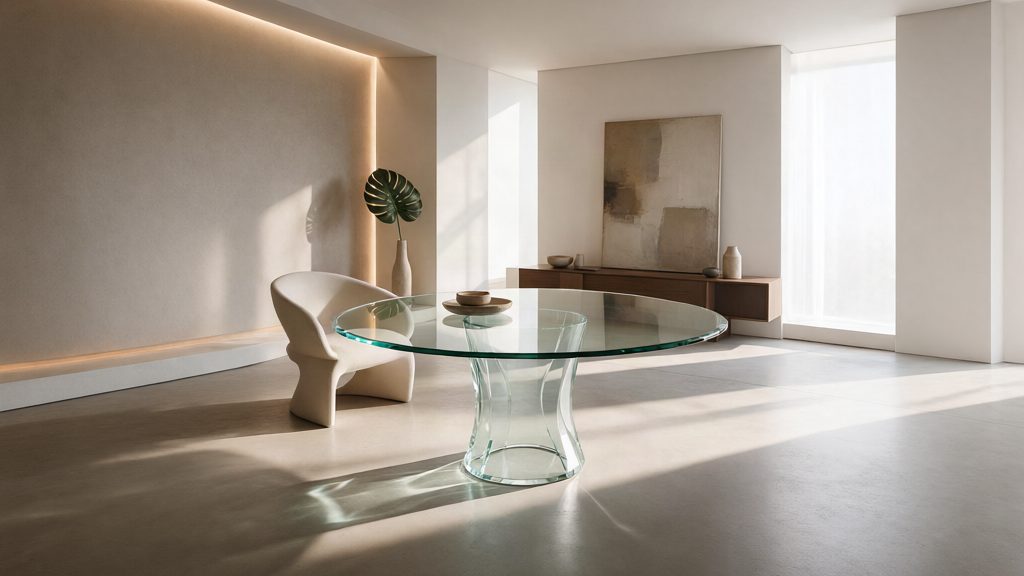
A glass tabletop can change the way an office feels without requiring a complete furniture overhaul. Clear glass keeps a workspace visually open, reflects available light, and can make a desk or conference area look less bulky than solid wood or laminate furniture. For offices where durability and safety matter, tempered glass is commonly considered because of its increased resistance to thermal and mechanical stress compared with ordinary annealed glass. Choosing the right Clear Round Tempered Glass Table Top for office use, however, involves more than selecting a diameter. The glass thickness, edge treatment, support structure, intended use, and installation method all affect whether the finished table is appropriate for the workspace.
Why Round Glass Works Well in an Office
A round office table has a practical advantage that rectangular furniture does not: there are no sharp corners extending into walkways. This can be useful in compact offices, reception areas, collaborative spaces, and meeting rooms where people regularly move around furniture.
The circular shape also changes how people interact around a table. A round conference or meeting table allows participants to face one another without positioning anyone at the head of the table. For small team discussions, interviews, consultations, and collaborative work, this can make the furniture arrangement feel less formal.
Clear glass also preserves the visual appearance of the table base underneath. A wood pedestal, metal frame, architectural base, or custom support system remains visible rather than being hidden beneath an opaque tabletop.
Current U.S. listings show round glass tops being marketed for office desks, lobby tables, coffee tables, dining tables, and conference applications, demonstrating how broadly this tabletop format is used.
Tempered Glass vs. Regular Glass for an Office Table
The most important distinction is not simply whether a tabletop is glass, but what type of glass it is. Tempered glass is heat-treated so that it has greater resistance to thermal and mechanical stresses than comparable annealed glass. If fully tempered glass breaks, it generally fractures into many smaller pieces rather than producing the large, sharp shards typically associated with broken annealed glass.
That does not mean tempered glass is unbreakable. A hard impact, damage to an edge, manufacturing defect, improper installation, or unsuitable support can still result in breakage. Tempered glass should therefore be treated as a safety-oriented material, not as a material that cannot fail.
The National Glass Association specifically notes that heat-treated glass cannot be cut, drilled, or edged after tempering because post-tempering fabrication can compromise the glass and cause breakage.
This matters when planning an office desk. Any holes for cable management, mounting hardware, center supports, or other fittings need to be specified before the glass is tempered.
Choosing the Right Thickness
Glass thickness should be selected according to the tabletop's diameter, support arrangement, expected loads, and intended application. There is no single thickness that is automatically correct for every round office table.
Common thicknesses seen in U.S. glass tabletop applications include 1/4 inch, 3/8 inch, and 1/2 inch. Some specialized or heavy-duty applications may use thicker glass.
1/4-Inch Tabletop
A 1/4-inch tabletop can be appropriate for certain smaller or adequately supported applications, but it should not automatically be treated as suitable for every office table. A larger unsupported span can require greater thickness because stiffness and deflection become more important as the size of the glass increases.
3/8-Inch Tabletop
A 3/8-inch tabletop provides greater thickness and stiffness and is frequently used for larger furniture applications. Current U.S. tabletop listings describe 3/8-inch tempered glass as suitable for applications including desks, coffee tables, and other furniture.
1/2-Inch Tabletop
A 1/2-inch tabletop provides additional mass and stiffness and is commonly available for larger round tops. For example, current U.S. listings include 1/2-inch tempered round tops intended for office, lobby, desk, and conference-type furniture.
The important point is that thickness should not be selected by diameter alone. The support system underneath the glass is equally important.
How the Table Base Affects Glass Thickness
Two round tables with the same diameter can require different glass specifications because their bases may support the glass differently.
A tabletop supported continuously around its perimeter distributes loads differently from a tabletop sitting on a central pedestal. Likewise, a table supported at several points behaves differently from one spanning a large open area.
For this reason, furniture designers and glass professionals consider the relationship between glass size, thickness, support locations, and expected loading rather than relying on a universal “weight limit.”
The National Glass Association's technical guidance also distinguishes glass strength from stiffness: changing from annealed to fully tempered glass does not automatically make a same-size, same-thickness piece stiffer. Thickness and geometry remain important considerations for deflection.
That distinction is frequently overlooked when people search for a tempered glass desk top. Tempering improves strength and changes the breakage characteristics, but it does not eliminate the need for proper structural support.
Measuring a Round Office Glass Tabletop
For a replacement glass tabletop, accurate measurement starts with the diameter. Measure across the existing tabletop through the center from one outside edge to the opposite outside edge.
If the existing top is unavailable, measure the supporting frame or base and determine the desired finished diameter. Do not assume that the dimensions of the base automatically represent the required glass dimensions.
For a glass replacement, also inspect the support surface. Check whether the old tabletop sat directly on the frame, used suction cups, rubber bumpers, setting blocks, or another mounting method.
If the glass will be used as a new desktop rather than replacing an existing tabletop, determine the working surface required for monitors, keyboards, documents, phones, and other equipment before selecting the diameter.
A round table intended for a small private office may need considerably less surface area than a conference table designed for several people.
Edge Finishes Matter More Than They Appear
The edge is one of the most important details of a glass tabletop because it affects both appearance and handling.
A flat polished edge produces a clean, contemporary appearance. A pencil-polished edge has a softer rounded profile. A beveled edge introduces an angled decorative surface, while more elaborate edge profiles can create a furniture-oriented appearance.
For an office environment, edge treatment should be selected according to the furniture design as well as practical handling requirements. A polished edge is generally preferable to an unfinished sharp edge because the exposed perimeter is part of the usable furniture surface.
Clear Glass and the Office Environment
Clear glass works particularly well when the goal is to maintain visual openness. Unlike opaque materials, it allows the underlying base and surrounding floor area to remain visible.
This can be useful in smaller offices where visually heavy furniture makes the room feel crowded. A transparent tabletop can also work with a wide range of interior styles because the supporting furniture becomes the dominant visual element.
There is one optical characteristic worth understanding: ordinary clear glass can have a slight green tint, particularly when viewed through the edge or when thicker glass is used. Low-iron glass can provide higher visual clarity and reduce that green appearance, although the exact appearance depends on the glass specification and viewing conditions.
Cleaning and Daily Maintenance
One reason glass is popular for office furniture is its relatively straightforward maintenance. Dust and fingerprints are easy to see on a clear tabletop, but they are also easy to remove. A clean microfiber cloth and an appropriate glass cleaner are generally sufficient for routine cleaning.
Avoid placing abrasive materials directly on the glass surface. Small particles trapped underneath objects can potentially scratch the surface when those objects are dragged across the tabletop.
The edges deserve attention as well. When cleaning, avoid striking the perimeter with hard objects. Even though tempered glass is stronger than annealed glass, its edges can remain particularly vulnerable to damage.
Office Equipment and Heat Sources
Modern office desks often hold more than paperwork. Monitors, laptops, docking stations, desk lamps, charging equipment, speakers, and other electronics may all occupy the tabletop.
Before placing unusually heavy equipment on a glass desk, consider how the load is distributed. A concentrated load placed over a small area can behave differently from a uniformly distributed load.
Heat is another consideration. Tempered glass has improved resistance to thermal stress, but that does not make it immune to thermal shock. Extremely hot objects should not be placed directly on a glass surface without considering the manufacturer's recommendations and the condition of the glass.
When a Round Glass Top Is Used as a Replacement
A replacement glass tabletop can be useful when an existing furniture frame remains structurally sound but the original top is damaged, outdated, or missing.
The replacement process is relatively straightforward conceptually: identify the required diameter, thickness, glass type, edge finish, and support arrangement. The difficult part is getting those specifications right.
Do not simply order a replacement based on the original glass thickness unless you know the original design was appropriate. If the furniture has been modified, relocated, or repurposed, the new application may have different requirements.
For example, converting a small decorative table into an office workstation changes the type and distribution of loads placed on the surface.
Common Mistakes to Avoid
One common mistake is assuming that thicker glass automatically means a safer table. Thickness is important, but the quality of fabrication, edge treatment, support structure, installation, and intended use also matter.
Another mistake is attempting to modify tempered glass after delivery. Drilling a hole for a cable, trimming the diameter, or grinding an edge is not a normal DIY modification. Industry guidance states that these fabrication processes should be completed before heat treatment.
A third mistake is ignoring the condition of the table base. A high-quality glass tabletop cannot compensate for an unstable pedestal, damaged frame, uneven support, or poorly positioned mounting points.
How to Choose the Specification
For an office project, start with the intended function rather than the appearance. Determine whether the table is a personal desk, reception table, collaborative workstation, conference table, or decorative surface.
Next, establish the diameter and support structure. Then consider glass type and thickness, followed by edge finish and any holes or cutouts required for the furniture.
For example, a small round office desk with a well-designed support structure may have very different requirements from a large conference table with a substantial unsupported span.
If holes, notches, or other fabrication are needed, they should be incorporated into the design before the glass is tempered.
Final Considerations
A clear round tempered glass table top for office use combines several decisions that should be considered together: diameter, thickness, support, edge treatment, fabrication, and intended loading.
Tempered glass offers useful safety and durability characteristics, but it is not indestructible and should not be treated as a substitute for proper furniture engineering. The best specification is the one that matches the actual table design rather than simply choosing the thickest or most visually appealing option.
For offices, the appeal of a round glass tabletop ultimately comes from the balance between function and visual simplicity. When the dimensions, support structure, and glass specification are properly matched, a transparent tabletop can provide a durable working surface while keeping the surrounding office visually open and uncluttered.

