
The idea of hopping on a public bus for a short break is a fantasy in the lives of many Indian women. They need to get permission first; then they have to pay for the bus fare.
Karnataka, a state in the south of the country, is trying to change that. Some of the 35–40 million women in the state will still require permission to travel by public transport, but they won’t have to ask for money to pay the ticket price.
A Bold Move Towards Equality
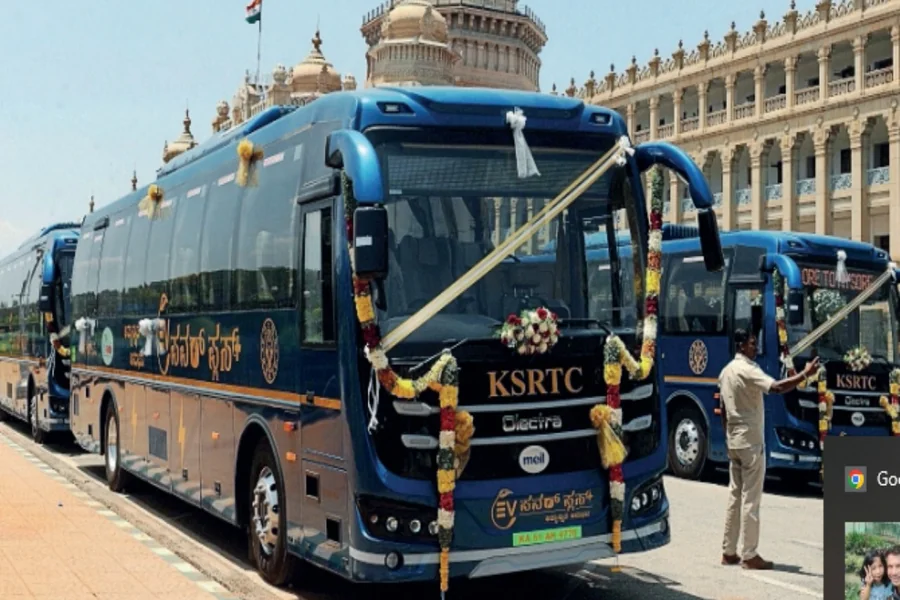
On 11 June, the state government announced free bus travel for transgender people and women. Women are now able to board any bus, at any time, and for any number of trips. A tidal surge of smiling women has seized buses. More than 40 million women have climbed on board in the first nine days.
In Dharwad district in Belagavi, an older woman in a worn-out sari began climbing the stairs. She bowed her head and let it almost touch the step in gratitude. Ningavva Acka told reporters that she used to have to ask her family for permission to travel and to give them money. “Now I’m not dependent on them.”This bold initiative has made bus ticket booking unnecessary for millions of women, removing yet another barrier to their independence.
Encouraging Women’s Workforce Participation
The policy is designed to encourage women to work. In India, women are underrepresented in the labour force. According to the latest World Bank statistics, women make up 23% of India’s workforce. This compares with 32% for Bangladesh and 34.5% for Sri Lanka.
With free transportation, it is hoped that more women will be able to look for work and travel further from home, while still saving money. Bus fares are a major deterrent to many women from seeking employment because they take a large chunk out of their wages.
One woman, a Bengaluru cleaner, told reporters that she could spend the money saved on more milk for her children. Another woman said, “I will be able to afford to feed my family better if I find a job.”
Personal Dreams and Joys Reignited
Ambika is a 37-year-old widow who works part-time as a maid in Mangalore. She plans to reward herself because she doesn’t have children. “I will save money to buy myself a gold bracelet.”
“On Sundays, my sister and I will go somewhere,” she said.
India’s Evolving Public Transport Schemes
It is not the first scheme of this kind in India. New Delhi’s government began offering free bus travel to women in 2019, but only within the city. Tamil Nadu has a similar policy, but it is only available for short distances.
Karnataka’s policy may change lives. Women of all ages, from young girls living at home to widows who live with their married sons, are forced to ask for money if they wish to travel.
Breaking Invisible Borders
“Women spend most of their time within a three to four kilometre radius, which they can reach by walking or travelling with a bus ticket for 10 rupees (10 pence). It’s almost like a border that poverty has created. It’s like an invisible border. They live within it. They can go shopping, or see their city, or even work,” said Srinivas Alavilli, a citizen activist in Bengaluru who believes that free public transportation will lead to social change.
He adds that when women flood public spaces, the landscape will change, and they will feel safer on the street.
Shifting Family Dynamics
He says that family dynamics will change. If parents are willing to pay for the girls’ travel, they will be less likely to resist their daughters’ desire to study further. Married women wanting to work will be able to argue with their husbands more effectively.
Alavilli explains, “The in-laws are currently saying it is too expensive, but when the cost of transport disappears, it will be harder to convince them to prevent their daughter-in-law from working.”
A Surge of Joy
The buses are creaking with the weight of thousands of ecstatic women. Ambika says, “There’s so much excitement about visiting family and temples or places that they haven’t been before. I will wait until the mass euphoria has died down, and then my sister is going to take me to a new temple.”
Challenges Ahead
The state government must increase the number of buses in order for the policy to be effective. Alavilli stated that no new buses have been added to Bengaluru’s fleet of 6,500 buses since 2014. With a population of 12 million, Bengaluru should have around 14,000 buses.
No one has yet complained about the overcrowding. They are too busy enjoying freedom.
A Moment to Remember
The excitement was so great that even the Chief Minister of the state, Siddaramaiah, became enthralled. He said,
“This picture will remain in my memory forever.”

