
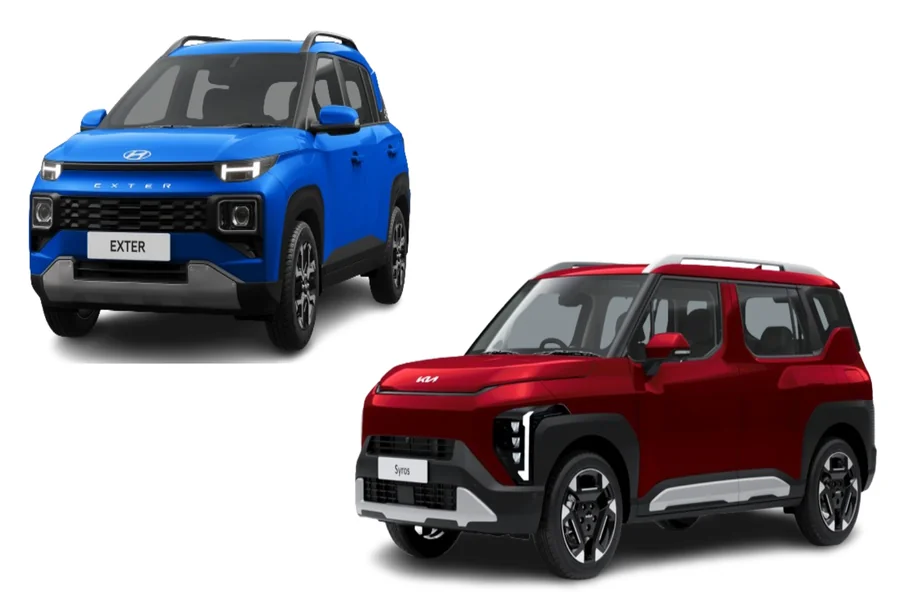
The Indian SUV market is no longer defined by a single category. Instead, it has evolved into clearly segmented layers, each designed to serve different buyer priorities. Among these, the distinction between micro-SUVs and compact SUVs has become increasingly important. The Hyundai Exter and Kia Syros illustrate this difference clearly. While both carry SUV design cues, elevated seating positions, and modern safety systems, they operate in distinct segments shaped by size, capability, and feature expectations.
Understanding the difference between these two formats helps buyers align their expectations more accurately with real-world needs.
What Defines a Micro-SUV?
The Hyundai Exter is positioned within the micro-SUV segment, typically defined by overall lengths between 3,800 mm and 3,900 mm. With an overall length of 3,815 mm and a wheelbase of 2,450 mm, the Exter is engineered for city efficiency and compact practicality.
Micro-SUVs are designed to offer:
- Urban manoeuvrability in dense traffic
- Compact proportions for tight parking spaces
- Elevated ground clearance compared to hatchbacks
- Accessible entry pricing
The Exter’s 1.2L Kappa petrol engine produces 83 PS and 113.8 Nm torque, which is tuned for efficient daily commuting rather than high-speed performance. It is also available with a CNG option, expanding its appeal to cost-conscious urban drivers.
Despite its smaller footprint, the Exter integrates six airbags as standard and over 40 advanced safety features across trims. This demonstrates how safety expectations are no longer reserved for larger SUVs.
What Defines a Compact SUV?
The Kia Syros occupies the compact SUV category, positioned above micro-SUVs in both size and technological integration. Its technical specifications indicate larger proportions than the Exter, allowing for greater cabin flexibility and broader feature integration.
Compact SUVs typically offer:
- Wider cabin space and improved shoulder room
- Larger infotainment systems
- Stronger engine options
- Advanced driver assistance systems
The Syros is powered by a Smartstream G1.0 T-GDi engine delivering 120 PS and 172 Nm torque, alongside a 1.5L CRDi diesel producing 116 PS and 250 Nm torque. These figures place it firmly above micro-SUV performance benchmarks.
In terms of safety, the Syros integrates Level 2 ADAS features, including Forward Collision Avoidance Assist, Lane Keep Assist, and Smart Cruise Control with Stop & Go. This reflects compact SUV expectations around advanced preventive safety.
Technology and Digital Integration
Technology integration further differentiates the two segments.
The Exter offers a 20.32 cm HD infotainment system with 60+ Bluelink connected features. Its 4.2-inch colour TFT MID provides essential digital information without overwhelming the dashboard layout.
The Syros, however, introduces a 76.2 cm Trinity panoramic display panel and supports over-the-air updates. The digital cockpit experience is significantly more immersive, reflecting the expectations placed on compact SUVs.
This difference illustrates how segment size often dictates the scale of digital integration.
Space, Flexibility, and Practicality
Interior flexibility is another key differentiator.
The Exter emphasises efficient packaging with generous headroom and a practical cabin layout. It is well-suited for small families and first-time SUV buyers upgrading from hatchbacks.
The Syros incorporates sliding and reclining rear seats, adding a level of adaptability uncommon in micro-SUVs. This feature enhances passenger comfort during long journeys and reflects its positioning as a more versatile family SUV.
The step from micro to compact is therefore not just about size—it is about flexibility.
Buyer Expectations and Research Behaviour
Micro-SUV buyers often prioritise affordability, ease of ownership, and fuel efficiency. Compact SUV buyers typically expect broader feature integration, higher engine output, and enhanced comfort.
Today’s buyers rarely depend solely on brochures or showroom visits. On platforms such as ACKO Drive, where specifications, safety systems, and variant differences can be compared in addition to buying cars online, the distinction between micro-SUVs like the Exter and compact SUVs like the Syros becomes clearer. Structured comparison helps buyers assess whether compact convenience or expanded capability better aligns with their needs.
Conclusion
The Hyundai Exter and Kia Syros clearly illustrate the difference between micro-SUV and compact SUV positioning. The Exter represents efficient urban mobility with strong safety integration in a compact footprint. The Syros offers greater power, space flexibility, and advanced digital immersion within a larger format.
In a diversified SUV market, understanding segment boundaries ensures buyers select vehicles that match their lifestyle rather than simply chasing features. The distinction between micro and compact SUVs is not about superiority—it is about suitability.

