
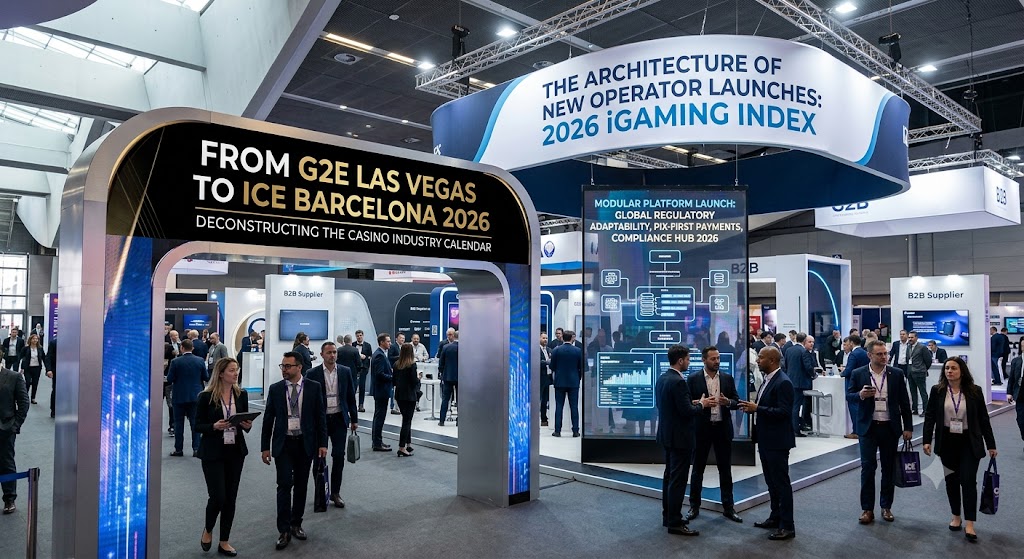
The G2E to ICE Barcelona Pipeline: Where Valuations Go to Die (or Multiply)
The global gambling calendar no longer dictates mere networking opportunities. It engineers exact corporate launch architectures. Let’s be real—the migration of ICE from London to Barcelona in 2026 fundamentally changed the operational timeline for every major B2B supplier on the planet. October’s Global Gaming Expo (G2E) in Las Vegas serves as the financial proving ground. North American mergers begin here as quiet whispers behind closed doors. The early-year Barcelona summit then forces operators to finalize their tech stacks before the Q1 earnings calls hit the wires. You cannot launch a multi-jurisdictional brand today without aligning your backend deployment precisely between these two massive trade events. The industry simply no longer tolerates delayed product roadmaps.
Building the Brazilian Moat in Real-Time
The transition of the Brazilian iGaming ecosystem from a tolerated grey zone to a hyper-compliant fortress is currently dominating development cycles globally. Operators attending ICE Barcelona are no longer bragging about top-line user acquisition metrics. Frankly, the conversation has violently shifted to survival through compliance architecture. Law 14.790/2023 mandates strict biometric-first onboarding. This framework forces platforms to integrate active liveness detection directly against the federal revenue database in real-time. Brands that fail this technological hurdle face immediate extinction in South America’s most lucrative jurisdiction. Look closer and you see exactly why operators like Kaizen Gaming are hoarding market share right now. Their proprietary unified sportsbook backend allowed them to deploy fully localized, compliant products within weeks. This agility sets a brutal, unmatchable pace for legacy competitors who still rely on bloated third-party software.
The iCasino Arbitrage and Affiliate Independence
North American operators finally woke up to a harsh financial reality this year regarding unit economics. The lifetime value of an online casino player completely obliterates the margins of a casual sports bettor chasing weekend parlays. Rush Street Interactive essentially proved this point by ignoring the ruinous promotional arms race entirely. The operator delivered a staggering $60.2 million Adjusted EBITDA in early 2026 simply by obsessing over its iCasino vertical. Market saturation, however, breeds profound consumer distrust among these high-value players. Gamblers are actively rejecting operator-led promotional copy because terms change constantly. The catch? They are turning to independent vetting mechanisms to cut through the noise. Players want verified bonus terms and authentic withdrawal tests, which is exactly why sites like Casinofy are gaining massive traction by applying repeatable, evidence-based scoring models that rank operators purely on merit. A smaller offer with fair terms always beats a massive headline trapped behind a predatory 60x wagering requirement. Lottomatica Group executed a similar margin-expansion strategy in Italy. The European giant pushed its online EBITDA margins to an absurd 57.5% through relentless omnichannel integration.
Distressed Assets and the M&A Chopping Block
European conglomerates view North America as an expensive bloodbath. They flatly refuse to ignore the liquidity, though. Allwyn AG sidestepped the traditional sports betting slaughterhouse entirely this cycle. The lottery giant simply wrote a $1.5 billion check to acquire PrizePicks. This calculated maneuver secured instant scale and a massive database of daily fantasy players without begging for heavily taxed sports betting licenses. Back across the Atlantic, the high-interest hangover is forcing distressed assets into brutal compromises before the Barcelona show floor even opens. Bally’s Intralot swooped in to absorb Evoke plc for roughly £2 billion. Legacy operators burdened with cheap credit from the pandemic era are now being cannibalized by better-capitalized entities who just want their regulatory licenses. Omnichannel supremacy is also driving massive physical consolidation. Billionaire Tilman Fertitta entered exclusive negotiations to acquire Caesars Entertainment for an estimated $18 billion enterprise value. Digital dominance still requires physical real estate anchors.
The Cost of Localized Infrastructure
The B2B supply chain is undergoing its own massive structural rupture behind the scenes. Evolution AB remains the absolute titan of live casino tech. Its recent financial reports show a distinct capital transition, however. The reality is that emerging markets now demand localized streaming infrastructure over generic offshore feeds. You can no longer just broadcast from a low-cost studio in Riga to the rest of the world and expect to pass regulatory muster. Evolution is currently bleeding capital expenditures to build physical studios in New Jersey, São Paulo, and Argentina. The board even temporarily suspended long-standing dividend policies just to fund this mandatory geographic expansion. True global scale requires physical concrete, not just rented cloud servers.
Tax Suicide in India versus the Philippine E-Gaming Surge
Geography dictates survival in this industry. National tax policies are currently creating wild market distortions across the map. The Supreme Court of India effectively nuked its domestic real-money gaming sector this year. They validated a catastrophic 28% tax on full deposit values. Domestic compliance in that region is now practically a death sentence for operator margins. Unsurprisingly, this legislative overreach sparked a $20 billion offshore grey market renaissance. Brands based in Curacao and Malta are happily absorbing the displaced Indian liquidity with zero regulatory friction. The Philippine Amusement and Gaming Corporation (PAGCOR) executed a brilliant pivot in stark contrast to India’s self-inflicted wounds. Digital gaming completely eclipsed physical casino revenues in the Philippines last year—generating over PHP 201 billion. Widespread smartphone adoption and integrated digital payment rails like GCash transformed the archipelago. It is now the most lucrative domestic-facing e-gaming hub in Asia.
African Margins and Transatlantic Capital Flight
Asset-light portfolios are outperforming bloated regional monopolies on a global scale. Super Group completely reorganized its reporting segments this year to reflect a simple truth. Africa is printing money. The continent generated $267 million for the company in a single quarter. This influx was driven almost entirely by raw iGaming adoption rather than traditional sports handling. Capital markets are ruthlessly efficient at recognizing these international trends. Financial markets are actively repositioning to capture the anticipated liquidity wave, prompting the BETZ ETF to transition from a passive index to an actively managed fund. Flutter Entertainment recognized the premium valuation multiples awarded by Wall Street and actively delisted from the London Stock Exchange. The center of gaming capital has permanently shifted to American indices. European exchanges are left starved for high-yield gaming technology.
Event Contracts and the World Cup Reality
Traditional sportsbooks face an existential threat from friction-free prediction markets as the 2026 World Cup approaches. Casual younger demographics treat wagering as financial trading. They prefer event contracts over traditional fixed odds. DraftKings aggressively purchased Railbird Exchange for nearly $85 million to build an in-house predictions platform. This defensive strategy reacts directly to the multi-billion-dollar valuations of native crypto trading spaces like Kalshi. Web3 platforms are compounding this threat by moving game logic entirely on-chain to provide cryptographically verifiable fairness. The upcoming 104-match World Cup across North America represents the largest customer acquisition event in digital wagering history. Operators are not just competing for temporary betting handles anymore. They are actively fighting to avoid technological obsolescence in a market that no longer forgives operational lag.

