
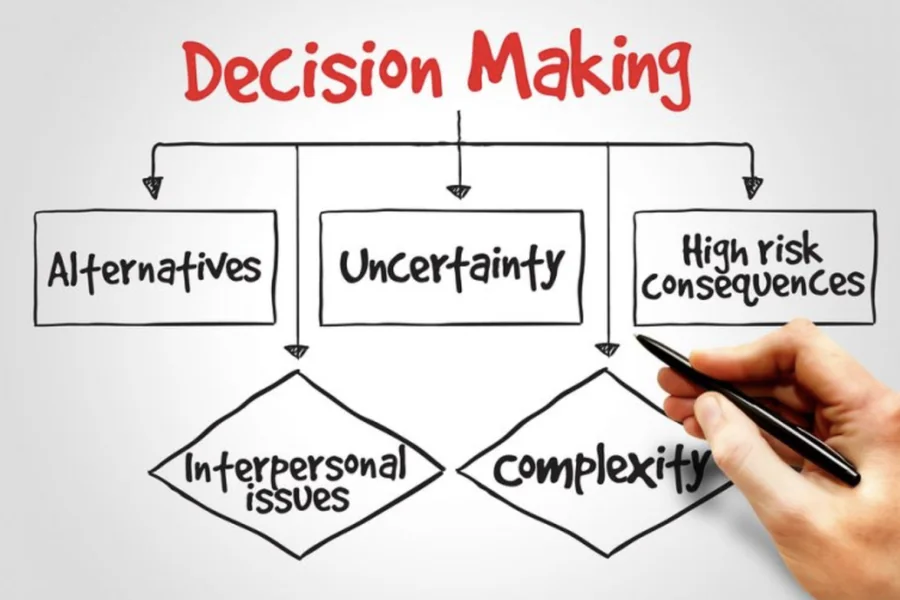
Whether you have ever watched odds change on the fly, spent a few minutes ticking the box on your dashboard and waiting until a market responded, or waited three seconds before clicking confirm, you have been subjected to decision theory at work.
Uncertain environments are real-time and compress choice. They eliminate the pleasure of contemplation and substitute it with dynamic data, time, and changeable incentives. To viewers accustomed to live betting, odds stations, and bonus clocks, the mechanisms are intuitive. However, there is more to it than that intuition that structures the relationship among mathematics, neuroscience, and behavioral economics.
Uncertainty: Risk, Ambiguity and the Speed of Choice.
Decision theory starts with a simple question: what should we do when we do not know the consequences?
Uncertainty is of two fundamental kinds:
- Risk: the probabilities are known (or at least supposed).
- Ambiguity: even the probabilities are vague.
In real-time digital systems, the two exist. There is a sight of odds–but everlasting change. The flow of information is unending. The atmosphere is clear, but airy.
The principle of expected value is at the center of it:
EV=∑(pi×xi)EV
This equation means what is not very complicated: each outcome is multiplied by its probability and added. Rational agents are expected to maximize the expected value in theory.
In practice? Humans maximize emotional coherence.
We are not calculators. We are predictive machines that navigate through missing information, besides coping with dopamine, stress, and fatigue of decision-making.
The Brain Under Pressure: Dopamine, Time and Cognitive Bias.
The brain gears when decisions are taken in real time.
The Fast and the Focused
In cases of time pressure, an analytical part of the brain (the prefrontal cortex) sacrifices control to quicker emotional pathways. The amygdala flags risk. Circuits of dopamine anticipate reward. Such interaction forms a dopamine loop as described by behavioral economists.
Variable rewards – results that are provided at random – are particularly effective. They generate stronger involvement than fixed rewards. This does not apply specifically to gambling; it is inherent to digital interaction, whether through social media notifications or trading platforms.
The result:
- More dependence on the heuristics.
- Amplified cognitive bias
- Reduced analytical depth
- Increased response to near-miss.
- The real-time environment compounds these effects since they are a combination of:
- Immediate feedback
- Rapid information updates
- Social comparison signals
- Countdown timers
This cocktail amplifies the impulse to gratify and makes one more susceptible to such biases as:
- Availability heuristic
- Overconfidence bias
- Gambler’s fallacy
- Confirmation bias
And with all decisions, we face decision fatigue, the diminishing mental energy in the repetition of decisions. Fatigue does not present itself much in the digital systems. It only renders the following click a little less rational.
Between Expected Value and Subjective Utility.
Expected value is simply mathematical. It is psychologically incomplete.
Human beings do not appreciate benefits in proportion to their value. The initial $100 is more important than the tenth 100. This decreasing sensitivity may be expressed as a concave utility function:
U(x)=xU(x)
This curve summarizes the main behavioral lesson: we tend to be risk-averse to gains and risk-seeking to losses.
Prospect Theory formalizes this asymmetry and brings in three key concepts:
- Declines are even greater than profits.
- Results are compared to a reference point.
There is an error in the perception of probability–underweighting big and overweighting small probabilities.
Reference points in the real-time systems are never fixed. A recent victory erases anticipations. A loss triggers risk-seeking behavior. It is not only that the environment becomes uncertain, but also that it is emotionally dynamic.
Bayesian Thinking in a Streaming World.
Information streams are digital environments. Odds update. News breaks. Patterns emerge.
Decision-makers are supposed to revise beliefs by Bayesian logic normatively:
P(A∣B) =P(B∣A) P(A)P(B)P(A|B)
This model explains how old beliefs are modified in response to new information.
But human beings do not clean up well. Instead, we:
- Reference to first impressions.
- Overreact to recent events.
- Underweight base rates
In non-simulated, uncertain systems, this leads to recency bias and inflated momentum effects. There is a brief streak, which is a trend. It is a feeling of inevitability of a trend.
The brain is fond of continuity of the story–where even the laws of probability would tell that continuity should be broken.
Digital Architecture and Behavioural Patterns.
The question now is how platform design relates to these mechanisms.
Real-time systems may not be devoid of:
- Dynamically changing displays of probability.
- Personalized recommendations
- Progress indicators
- Reward multipliers
- Social proof metrics
A global betting site, such as one, combines global liquidity and cross-market information, allowing users to engage with ever-changing odds. The structure’s design is not only technical; it also influences cognition.
Games such as Vave Casino Global feature highly dynamic environments in which real-time updates, interfaces, and dynamic reward systems drive micro-decisions continuously. Regardless of whether one is actively involved or is merely a spectator, the system demonstrates how the three factors of uncertainty, speed, and behavioral economics come together.
They are bottlenecks of decision theory; these platforms are not merely entertainment ecosystems.
And the more fluid the system, the greater the cognitive load it places.
Decision Fatigue and the Illusion of Control.
The faster the decision-making frequency, the lower the brain’s bandwidth.
Studies about decision fatigue demonstrate that:
- Risk tolerance changes over time.
- Impulsivity increases
- There is deterioration in analytical processing.
Users can experience a mix of hyper-engagement and mental exhaustion during long periods of uncertainty in the digital environment, a paradox of high-intensity digital use.
The illusion of control is yet another psychological factor in effect. Perceived agency is facilitated with real-time interaction. The instant the results are changing, and the feedback is instant, it seems the skill is taking over the randomness, even though the underlying probabilities may be the same.
It is not necessarily an irrational perception; it is the way interactive systems obliterate the distinction between stochastic processes and user input.
Design Ethics, Nudging and Cognitive Transparency.
The nexus of decision theory and digital architecture brings up serious questions.
Where is the line between?
- Manipulation and maximization?
- Interaction and manipulation?
- Nudging and coercion of behaviour?
Real-time systems are influential because they correspond to natural neural processes in this mentioned international betting site. They enhance expectations of rewards, promote pattern recognition, and leverage cognitive biases.
Ethical design involves transparency in presenting probability, clarity in feedback systems, and respect for cognitive limits. Otherwise, engagement strategies will tend to exploit behavioral weaknesses rather than promote informed choice.

