
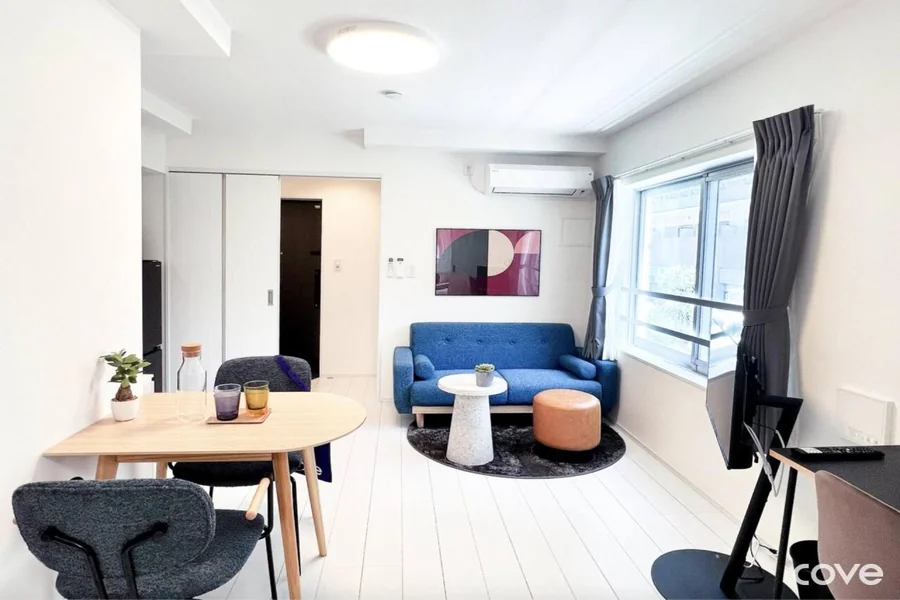
Cove Japan is a Tokyo furnished room operator that designs its rentals to be accessible to foreigners. The most common barriers to renting in Japan, including the Japanese guarantor requirement, large upfront key money payments, and Japanese-only paperwork, are removed by default at Cove Japan. This guide explains how Cove Japan is set up for foreign tenants and which Cove Japan property might fit your situation.
The Friction Foreigners Face in the Japanese Rental Market
The traditional Japanese rental market presents several friction points for foreigners arriving in Tokyo. The biggest is the guarantor requirement (保証人), where most landlords require a Japanese citizen with stable income who can take responsibility for unpaid rent. Foreigners without local networks often cannot meet this. Beyond that, there’s key money (礼金), a non-refundable payment of 1-2 months’ rent to the landlord. There are agent fees, fire insurance, lock change fees, and other initial costs. Most Japanese apartments are unfurnished, requiring tenants to source furniture, appliances, and utility contracts on arrival. And throughout the process, lease agreements and tenant correspondence often happen entirely in Japanese. These hurdles can delay move-in by weeks and add hundreds of thousands of yen to the move-in cost.
How Cove Japan Maps to Each Friction Point
Cove Japan is built around six promises that map directly onto these friction points: no guarantor required, no key money charged, fully furnished apartments including appliances, optional rather than mandatory housekeeping, flexible 1-month minimum stays instead of fixed-year contracts, and English support across all channels. The result is an apartment a foreigner can book online, sign a digital contract for, and move into without a Japanese network or in-country presence. Live options are listed on Cove Japan’s Tokyo apartments for foreigners search page.
Who Cove Japan Suits
Cove Japan’s furnished apartments suit a few specific foreigner profiles particularly well. The first is expats relocating to Tokyo. With one-month minimum stays and immediate move-in availability, tenants can use Cove Japan as a soft-landing apartment while they decide on a longer-term neighborhood, or stay for the duration of an assignment. The second is international students enrolled at Tokyo universities. The guarantor requirement is one of the most common rejection reasons for student rentals, and Cove Japan removes that requirement entirely. Cove Japan’s Grande Komaba property in Meguro-ku is located near the University of Tokyo’s Komaba campus.
The third profile is digital nomads on Japan’s digital nomad visa. Japan introduced the visa in 2024, allowing eligible remote workers to stay for up to six months. Because the visa is non-extendable beyond six months, traditional Japanese leases (often two-year contracts) are a poor fit. Cove Japan’s one-month minimum stays and fully furnished apartments align with the digital nomad visa timeline. The fourth is couples and families. Cove Japan offers larger 1-bedroom and 2-bedroom apartments for partnered tenants and small families. The Gatehouse Asakusa Kaminarimon offers multiple 2-bedroom configurations, while Renaissance Court Kinshicho II includes spacious 1-bedroom layouts. For couples relocating together, the no-guarantor and no-key-money policies are particularly accessible, since traditional Japanese rentals often require both partners to provide separate guarantor documentation.
English Support Across Every Channel
Cove Japan offers English-language support across all customer channels, including LINE chat at @covejapan, WhatsApp via the website, and the iOS and Android booking app.
Where the Properties Are
The eight Cove Japan properties span five Tokyo wards. Renaissance Court Kinshicho II is in Sumida, Cove Kiyosumi Shirakawa in Kōtō, Grande Komaba and Prime Urban Senzoku in Meguro, Joyous Gard Yoyogi and Cove Ebisu by Tokyo Beta in Shibuya, and GENOVIA Okachimachi Skygarden and The Gatehouse Asakusa Kaminarimon in Taito. This distribution gives foreign tenants access to upscale residential areas (Ebisu, Komaba, Senzoku), Old Tokyo neighborhoods (Asakusa, Okachimachi), and central business-adjacent locations (Kinshicho, Yoyogi).
Booking from Abroad
The booking process is the same for foreign and local tenants: browse listings on the website, virtual viewing through the online tools, then sign a digital contract and move in. Pricing varies by property and unit type with studios start from around JPY 200,000 per month at Cove Kiyosumi Shirakawa, 1-bedroom apartments from around JPY 250,000 per month at Grande Komaba, and 2-bedroom apartments from around JPY 439,000 per month at The Gatehouse Asakusa Kaminarimon. For a foreigner planning a move to Tokyo, that means most of the unpredictable costs of relocating, including the deposit-key-money-agent-fee-furniture stack, collapse into one predictable monthly figure.

