
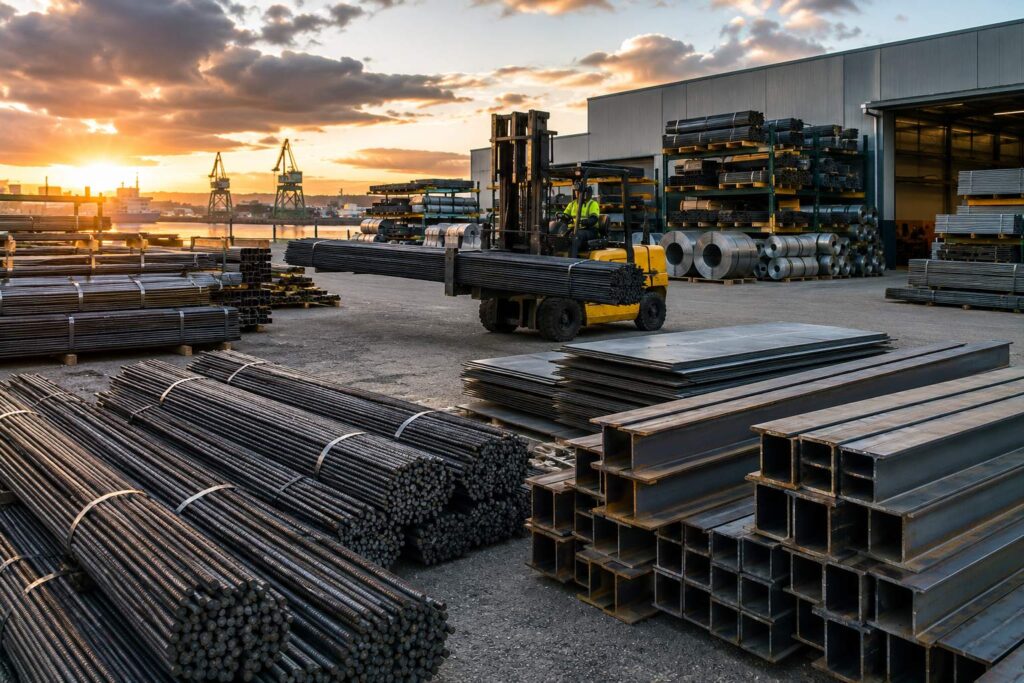
Behind every newly built house or energy project in the Baltic region lies a supply chain of steel and metals that most consumers never think about. Steel beams, reinforcement bars and metal sheets travel through distribution networks long before they become a roof, a foundation or a wind turbine component.
Tibnor as a driving force in the Nordic supply chain
Tibnor operates as part of the SSAB group and distributes steel and metal products to roughly 10,000 customers across the Nordic and Baltic markets. That scale lets the company negotiate stable sourcing from multiple producers, not only SSAB itself, which matters when a construction site needs a specific grade of beam on short notice.
The Estonian branch handles this locally. Local warehousing paired with fast delivery means a contractor in Tallinn doesn't wait weeks for material shipped from a distant mill, because Tibnor keeps stock levels tuned to what regional builders and manufacturers actually order.
Why steel quality matters more than expected
Material choice determines how long a structure lasts. Most ordinary buildings are designed for a 50-year service life under Eurocode standards, but a reinforcement bar produced under inconsistent quality control loses tensile strength years before that: uneven rolling temperatures leave micro-fractures that only surface under sustained load, and that weakness stays hidden inside concrete until cracks appear or a load-bearing element fails. The apartment building someone buys and the district heating pipe running under their street both depend on suppliers who verify steel composition and certify batches to EN 10204 3.1 before they leave the warehouse. Skipping that certification step doesn't save money, it moves the cost downstream to whoever inspects the building two decades later.
The overlooked assumption in the material chain
Most people assume steel quality is purely an industrial concern, something engineers argue about in specification sheets. In practice, local warehousing and logistics decide price and delivery time just as much as metallurgy does, and those two factors hit consumer projects directly.
Experienced site managers know a shortcut around this problem. A mill certificate without a matching heat number is functionally useless on a Baltic construction site, because inspectors cannot trace the material back to its casting record and reject the delivery outright. Warehouse staff who check that number before a beam leaves the yard save a project days of dispute later, a detail that rarely appears in a specification sheet but decides whether a delivery clears inspection on the first attempt.
Baltic industry's growing need for reliable metal suppliers
Construction and energy projects in the Baltic states are expanding faster than domestic steel production can absorb, and manufacturing capacity follows the same curve. Wind farms, district heating upgrades and new industrial facilities all compete for the same rolled steel and structural profiles. A supplier with warehouse capacity inside Estonia sidesteps the customs delays and long-haul freight disruptions that stall projects dependent on imports from further afield, and that resilience matters more as regional demand keeps climbing.
A stable supply of steel and metals is not an abstract industrial statistic. It sets the delivery date on a wind turbine foundation, the price per ton on a warehouse extension, and the tensile strength inside every reinforcement bar poured into Baltic concrete this year.
Frequently asked questions
What does Tibnor supply to the Baltic market?
Tibnor supplies steel, metals and related processing and logistics services to the construction, energy and manufacturing industries. The materials come from both SSAB and other producers, and the company serves roughly 10,000 customers across the Nordic region and the Baltic states.
Why does local warehousing matter for construction projects?
A local warehouse in Estonia cuts delivery time significantly compared with importing from producers further away, because transport distance and customs delays are the two factors most likely to derail a schedule and inflate its total cost.
Is steel quality only relevant for industrial customers?
No. Steel quality in reinforcement bars and structural profiles determines the durability of homes, energy plants and infrastructure that private consumers rely on daily. Failures in material quality often surface only decades later, once the cost of fixing them has grown far larger.
Which industries are drawing most heavily on Baltic steel supply right now?
Construction, the energy sector and manufacturing show the strongest growth in demand, with wind energy projects and district heating upgrades placing particular pressure on the availability of structural steel.
How does Tibnor Estonia differ from a standard importer?
Tibnor Estonia AS holds its own warehouse stock and manages delivery locally instead of relying on one-off import shipments. That setup shortens delivery time and keeps supply more stable during periods of high demand.

