
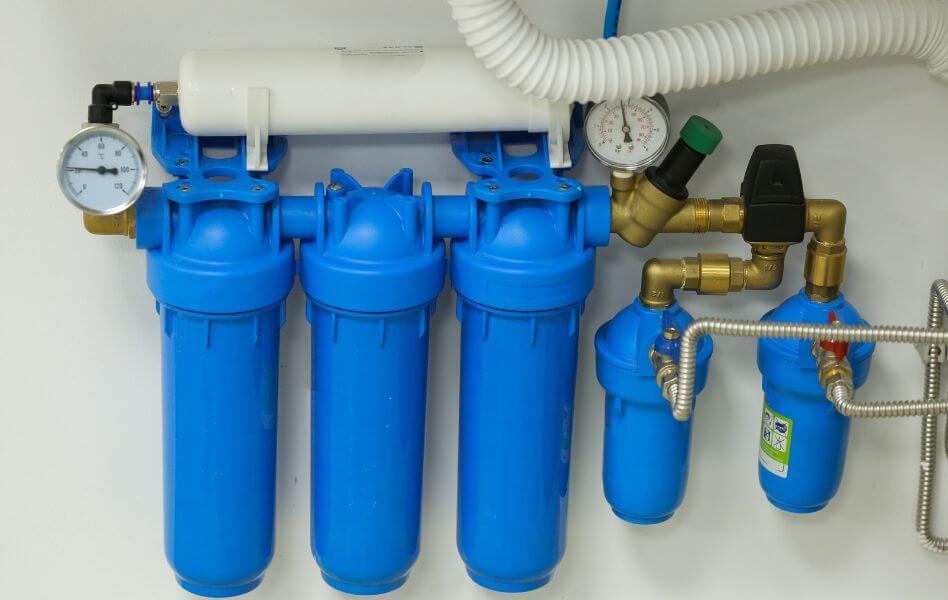
In this era of increasing water quality anxiety, when we turn on the faucet every day, have we ever thought about what is hidden in the seemingly clear tap water? Aging water supply pipes, secondary water supply pollution, disinfection by-products… Behind these terms, there are health hazards that every family has to face. Today, let us unveil the mystery of the kitchen Under Sink Filter, see how it builds a health line of defense for us.
Tap Water Pollution: The Invisible Health Killer
Tap water is obviously up to standard when it leaves the factory, why does it become “dangerous” when it arrives at home? I’m afraid this is the confusion of many urbanites. In fact, tap water from the water plant to our taps, to experience a long “journey”. In this process, the old municipal pipelines, community secondary water supply tanks can become a source of pollution. I have personally seen the community clean the water tank discharged turbid sewage, there are even rusty iron and small insect carcasses, such water even after chlorine disinfection, will allow us to drink with confidence?
More worrying is that, in addition to the naked eye visible sediment, rust, but also lurks in the tap water more invisible threats. Residual chlorine and its by-products, heavy metal ions, antibiotic residues … These pollutants accumulate in the body over time and may cause various chronic diseases. Studies have shown that although the heavy metal content in tap water in some areas “meets the national standard”, long-term consumption may still have an impact on children’s neurological development. In the face of this situation, installing an efficient Under Sink Filter is no longer an option to “improve the quality of life”, but a necessary measure to protect the health of your family.
Under Sink Filter: The Kitchen’s “Kidney” System
If we compare the human body to a sophisticated system, then the kidneys are our natural filters. Under Sink Filter is the “artificial kidney” installed for the whole family’s water health. Under Sink Filter has a stronger capacity and more comprehensive protection than traditional faucet filters or simple water filters.
These products are usually installed in the kitchen sink below the cabinet, through a multi-stage filtration system for tap water purification in depth. Take the hot system on the market as an example, it adopts three-stage filtration technology: the first stage removes sediment, rust and other large particles through precision filters; the second stage uses activated carbon to adsorb residual chlorine, organics and odors; and the third stage removes heavy metals through a special ion exchange resin. This combination of filtration methods can effectively deal with all kinds of pollutants in tap water.
It is worth mentioning that the design of modern Under Sink Filter has been very humanized. For example, some pre-filters have an automatic backwash function, no need to manually clean, only need to regularly replace the cartridge can be. Installation is also quite easy, with most products coming with detailed installation guides and videos, so even someone who knows nothing about DIY can complete the installation in less than two hours. Even better, these systems are usually designed to be very compact, so they don’t take up too much cabinet space, yet provide healthy drinking water for the whole family.
Pollutant Treatment Capacity Revealed
What exactly does the Under Sink Filter filter? How efficient is the treatment? This is the question that consumers are most concerned about. Let us use data to speak, in-depth understanding of different types of filters processing capacity.
Physical Pollutant Treatment
Under Sink Filter performs well for suspended matter visible to the naked eye, such as sediment, rust, colloids, etc. Products with PP cotton cartridges or ultrafiltration membranes can remove up to 99% or more of particles with a particle size larger than 1 micron. I have done a small experiment: two cups of tap water will be left to stand for 24 hours, unfiltered the bottom of the cup appeared obvious sediments, while the filtered water is still clear and transparent. This comparison visually demonstrates the effect of the filter on the interception of suspended solids.
Treatment of Chemical Contaminants
Residual chlorine is the most common chemical contaminant in tap water. Although it is used to sterilize and disinfect water, excessive residual chlorine produces an unpleasant odor and may increase the risk of cancer with long-term exposure. Activated carbon cartridges generally remove more than 95% of residual chlorine and can significantly improve the taste and odor of water. More surprisingly, quality activated carbon can also adsorb up to 60 kinds of organic pollutants, including pesticide residues and endocrine disruptors.
Heavy metal pollution is another headache. Traditional water purification technology has a limited effect on the removal of lead, mercury and other heavy metals, while modern Under Sink Filter uses ion exchange technology and KDF filter media, which can remove up to 90-99% of heavy metals. Take the measured data of a brand as an example, the lead content in the water before filtration is 15μg/L, and after filtration it drops to 0.5μg/L, which is a very significant effect.
Treatment of Biological Pollutants
Although tap water is sterilized by chlorine, secondary pollution in the pipeline may still lead to bacterial growth. Under Sink Filter with ultrafiltration membrane or UV sterilization technology can remove bacteria and viruses up to 99.99%. This protection is especially important during the summer heat period or in older neighborhoods.
It’s worth noting that products at different price points do vary in their treatment capabilities. Entry-level products may only be able to handle basic suspended solids and residual chlorine, while high-end products can handle more complex pollution situations. Consumers should choose the most suitable product based on local water quality and their own needs.
Selection Guide: How to Find the Right Under Sink Filter for You
In the face of a wide range of Under Sink Filter products on the market, consumers often feel at a loss. In fact, buying the right filter is not complicated, as long as you master the following key points:
l Filter combination determines the filtration effect. For ordinary urban tap water, activated carbon + ultrafiltration membrane combination has been able to meet most of the needs; if the water quality is harder or higher content of heavy metals, you should consider adding ion exchange or RO reverse osmosis technology products. It is worth noting that RO technology, although it has the best filtration effect, will produce a certain percentage of wastewater, which may not be the optimal choice in water-scarce areas.
l Cartridge life is just as important as replacement cost. Some products are inexpensive, but the cartridge needs to be replaced every 3 months, making it more costly in the long run. A good quality composite cartridge will usually last 12-24.
l Installation space and convenience are also factors to consider. The height of a standard Under Sink Filter is usually around 40cm, so be sure to measure the available space in your own cabinets before purchasing. In addition, the choice of products with a quick-connect interface can greatly simplify the installation process, some brands also provide free door-to-door installation service, not good DIY users are very friendly.
l Finally, the certification mark is an important guarantee of product quality. NSF certification is the gold standard in the water purifier industry, through the NSF42 (taste), NSF53 (health effects) and NSF401 (emerging pollutants) certified products, its filtration effect has the authority to guarantee.
Use and Maintenance: Getting the Best Out of Your Filter
Buying the right filter is only the first step; proper use and maintenance are equally important. Many users complain about unsatisfactory filter results or short life, often due to improper use.
Filter cartridge replacement is the most critical maintenance work. Even for the best quality filter cartridge, the filtration effect will be greatly reduced after exceeding the usage period, and it may even become a secondary source of pollution. I recommend setting up a cartridge replacement reminder on your cell phone or choosing a product with a smart reminder function. Generally speaking, PP cotton cartridges need to be replaced in 3-6 months, activated carbon cartridges 6-12 months, and composite cartridges can be used for 12-24 months.
Regular rinsing can extend the life of the cartridge. Even for products labeled “no rinse”, manual rinsing every 2-3 months can maintain the best working condition. For RO reverse osmosis products, it is important to check that the wastewater ratio is normal. Excessive wastewater usually means that the membrane element needs to be replaced or the system is malfunctioning.
Water quality monitoring is the best way to verify filtration effectiveness. A TDS pen can be used to test the dissolved solids content in the water (the TDS value should be significantly reduced after RO filtration), or a more specialized water quality testing kit can be used for an all-around test. Especially after replacing the filter element and the new filter installed after a week of use, water quality comparison test can visualize the filtering effect.
The last thing to remember is that the Under Sink Filter, while powerful, is not a panacea. It can not solve the whole house water quality problems, such as water heater scaling, washing machine water inlet impurities and other issues, but also need to cooperate with the pre-filter and water softener and other whole house water purification programs. Also, the filter cannot increase water pressure, and for areas with insufficient water pressure, an additional booster pump may need to be installed.
