
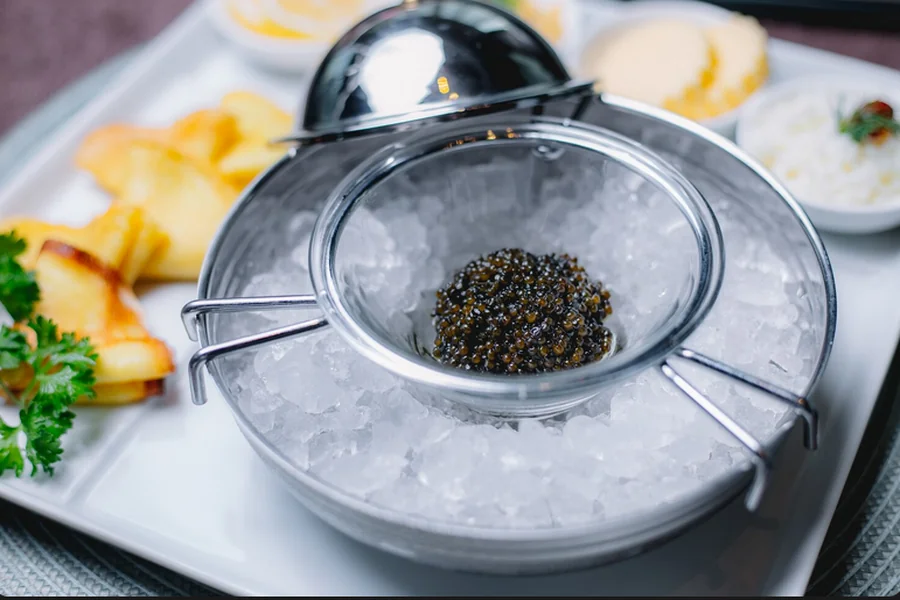
Open a tin of good caviar and the experience feels effortless — a clean smell, pearls that hold their shape, a flavour that develops slowly on the palate. Nothing about it suggests difficulty. That’s the point. What actually happened before that tin reached you is a years-long process involving biology, chemistry, refrigeration logistics, and a level of quality control that most food products never come close to. Here’s what it actually looks like.
The Hidden Complexity Behind a Small Tin of Caviar
Most luxury food products are complicated to source or prepare. Caviar is complicated at every stage simultaneously — and the timeline involved is unlike almost anything else in the food industry.
A female sturgeon raised for caviar production doesn’t reach maturity in months. Depending on the species, she may need 8 to 12 years before her eggs are ready to harvest. During that time, she requires carefully controlled water temperature, specific feeding schedules, and regular health monitoring. One bad year of husbandry doesn’t just hurt that year’s yield — it can set a fish back significantly, or compromise the quality of eggs she’ll eventually produce.
This is why caviar is expensive, and why shortcuts in production are so easy to detect in the final product. You can’t rush the biology. Everything downstream of that basic fact — the sorting, the salting, the grading, the packaging — is about preserving what took years to develop.
Sturgeon Farming and Harvest
Modern caviar production is almost entirely farmed. Wild Caspian stocks collapsed through the late 20th century, and most wild sturgeon fisheries are now closed or heavily restricted under CITES protections. What replaced them is a global network of aquaculture operations — in Italy, France, China, Uruguay, the United States, and elsewhere — that have spent decades refining the process.
Good sturgeon farms run closed-water systems, which means the water is filtered and recirculated rather than drawn continuously from a natural source. This gives producers control over temperature and chemistry, and prevents the fish from being exposed to pollutants or disease vectors from outside. It’s capital-intensive infrastructure, but it’s what makes consistent quality possible.
Harvest timing is critical. Producers monitor egg development through ultrasound — the same technology used in medical imaging — to assess maturity without harming the fish. When the eggs reach the right stage, the harvest happens quickly. Speed matters here: sturgeon eggs begin to degrade almost immediately after the fish is removed from water, and every hour counts.
Sorting, Salting and the Malossol Method
After harvest, the roe goes through a mesh screen to separate the eggs from the membrane. This has to be done carefully — torn eggs are unusable, and rough handling at this stage ruins texture. Experienced processors work quickly and by feel as much as by sight.
Then comes salting. The method used for premium caviar is called malossol, a Russian word that translates roughly as “little salt.” The name describes the approach precisely: just enough salt to preserve the eggs and enhance their flavour, without overwhelming them. Malossol caviar typically contains between 3% and 5% salt by weight.
Getting this right requires experience. Too little salt and the caviar won’t keep; too much and the flavour shifts in a direction that experienced tasters notice immediately. The salting is done by hand, mixed gently, and the caviar is then left briefly before the next stage. There’s no precise timer — seasoned processors judge readiness by appearance and texture.
Grading and Quality Control
Grading happens visually and by taste. Processors examine each batch for consistency of egg size, colour uniformity, firmness, and smell. Eggs that are broken, discoloured, or off in any way are separated out. What remains gets assessed for grade.
Grading systems vary by producer and region, but the general logic is consistent: higher grades reflect greater uniformity, better texture, and cleaner flavour. A single batch from one fish can produce eggs of different grades — it’s not a reflection of the fish’s overall quality so much as natural variation within a single harvest.
Tasting happens throughout. At every stage of production, experienced tasters check samples. They’re looking for anything that doesn’t belong: unusual bitterness, excessive brininess, any off-note that suggests something went wrong in farming, harvest, or handling. Most consumers never encounter substandard caviar from reputable producers precisely because this process catches problems before anything gets tinned.
Packaging and Cold Storage
Caviar is packed into tins — traditionally lacquered metal, sometimes glass — in a specific way. The tin is filled and then pressed slightly to eliminate air pockets, because oxygen accelerates spoilage. It’s then sealed and moved into cold storage immediately.
The temperature range for storing caviar is narrow: between -2°C and 2°C. Go warmer and the shelf life shortens quickly. Go colder and the eggs freeze, which destroys the texture irreversibly. Maintaining this range isn’t difficult in a well-equipped facility, but it requires consistent attention and reliable refrigeration infrastructure.
Pasteurised caviar — a different category — is heated briefly to extend shelf life significantly, making it shelf-stable at higher temperatures. The trade-off is texture and some flavour complexity. It’s a different product, useful for different purposes, but serious caviar consumers generally prefer unpasteurised.
The Final Step: How Caviar Reaches the Consumer
Finding good caviar for sale from a source that has maintained the cold chain throughout is genuinely important — more so than most perishable foods. Once a tin leaves the producer, it travels in refrigerated conditions through distributors, importers, and retailers before reaching the end buyer. Each handoff is a potential weak point. A few hours at the wrong temperature won’t necessarily make caviar unsafe to eat, but it will degrade the texture and shorten whatever shelf life remains.
Reputable suppliers pack orders with sufficient coolant for the expected transit time and ship via overnight or express services. When caviar arrives warm, or when a tin is damaged or swollen, those are signals that something went wrong in transit — and good suppliers will address it.
The best way to protect yourself as a buyer is straightforward: purchase from suppliers who are transparent about sourcing, storage, and shipping practices, and who have a clear policy for handling transit problems.
Final Thoughts
A small tin of caviar represents years of farming, hours of skilled processing, and a cold chain that has to hold from production facility to your table without interruption. None of that complexity shows in the finished product — which is, in a way, the whole point. The effort exists so that when you open the tin, all you encounter is the thing itself: clean, precise, exactly what it’s supposed to be.
Understanding what went into it doesn’t change the flavour. But it does change how you think about the price — and why cutting corners at any stage produces something noticeably worse.
