
In the early days of generative media, the community was obsessed with the “magic” of the prompt. We believed that if we could just find the right combination of descriptive adjectives and technical jargon, the AI would manifest a masterpiece from thin air. However, as the industry moves from casual experimentation to professional production, a more sobering reality has set in: generative video is a game of architectural integrity, not just linguistic flair.
The prevailing “fix it in post” mentality that has plagued traditional filmmaking for decades has mutated into a “fix it in the prompt” mentality in the AI space. But for tools like Nano Banana Pro, the quality of the output is almost entirely dictated by the structural quality of the input. If the first frame—the “seed”—is conceptually or technically flawed, no amount of prompt engineering can prevent the downstream motion from collapsing into a mess of artifacts and hallucinated pixels.
The Latent Anchor: Why Source Assets Are More Than Simple References
When you feed an image into a video diffusion model, the software doesn’t just see a picture of a person or a landscape. It interprets that image as a topographical map of latent values. Every pixel represents a coordinate in a multi-dimensional space. The model’s job is to predict how those coordinates should shift over time to simulate motion.
This is where the concept of “latent drift” becomes critical. If your source image, perhaps generated by a high-end AI Image Editor, contains ambiguous textures or poorly defined edges, the model lacks a solid “anchor” for its predictions. Imagine trying to animate a cloud of smoke versus a solid steel sphere. The AI understands the physics of the sphere because its boundaries are clear; the smoke, however, provides too many “correct” paths for the pixels to take, leading to the flickering and melting effects often seen in low-quality AI video.
High-contrast lighting and sharp focus in the source image act as stabilizers. When Banana Pro processes a frame with distinct highlights and shadows, it uses those high-frequency details to track the consistency of an object across time. If those details are mushy or “noisy” at the start, the model’s spatial awareness begins to degrade by the tenth frame, resulting in a video that feels like it’s being viewed through a layer of liquid.
Compositional Weights and Temporal Logic in Banana Pro AI
Composition is not just an aesthetic choice; in generative video, it is a matter of computational physics. Nano Banana Pro operates most effectively when the primary subject of the video is clearly delineated from the background. This is because the model must calculate two different types of motion simultaneously: the intentional movement of the subject and the “environmental” movement of the surroundings.
If you place a subject in the center of the frame—following a classic “Rule of Thirds” or centered composition—you reduce the computational load on the model’s edge-case logic. AI models typically struggle with “border artifacts,” where motion that begins or ends at the very edge of the frame fails to resolve correctly. By centralizing the action, you give the temporal engine more “buffer” pixels to work with.
Furthermore, cluttered backgrounds are the primary culprits for the dreaded “hallucinated limbs.” If the AI sees a background with complex patterns—like a dense forest or a busy city street—it may mistakenly interpret part of that background as an extension of the subject. During the generation process, a tree branch might suddenly turn into an arm. Using Nano Banana requires a disciplined approach to source assets where the background is intentionally simplified or depth-separated from the foreground to prevent these semantic overlaps.
The Resolution Trap: Why DPI Isn’t the Only Metric That Matters
There is a common misconception that simply upscaling an image to 4K will result in a better video. In reality, Banana AI is more interested in “semantic clarity” than raw pixel count. An image can have a high resolution but still be semantically “noisy.”
Semantic clarity refers to how easily the AI can identify the individual components of an image. For instance, a 1080p image with clean lines and a shallow depth of field is often far superior to a “grainy” 4K image where the foreground and background textures blend together. When the textures are too complex, the motion vectors become confused. The AI tries to animate the grain rather than the object, leading to a “boiling” effect on the surface of the video.
It is currently uncertain exactly why certain color palettes trigger more noise in diffusion models than others, but evidence suggests that overly saturated “neon” colors or extreme HDR ranges can sometimes cause the temporal consistency to break down faster. This is one of those areas where the operator must exercise practical judgment: sometimes a flatter, more neutral source image provides a safer canvas for the AI to work on, allowing for color grading to be handled in traditional post-production software later.
Refining the Seed: Practical Pre-Processing for Professional Video
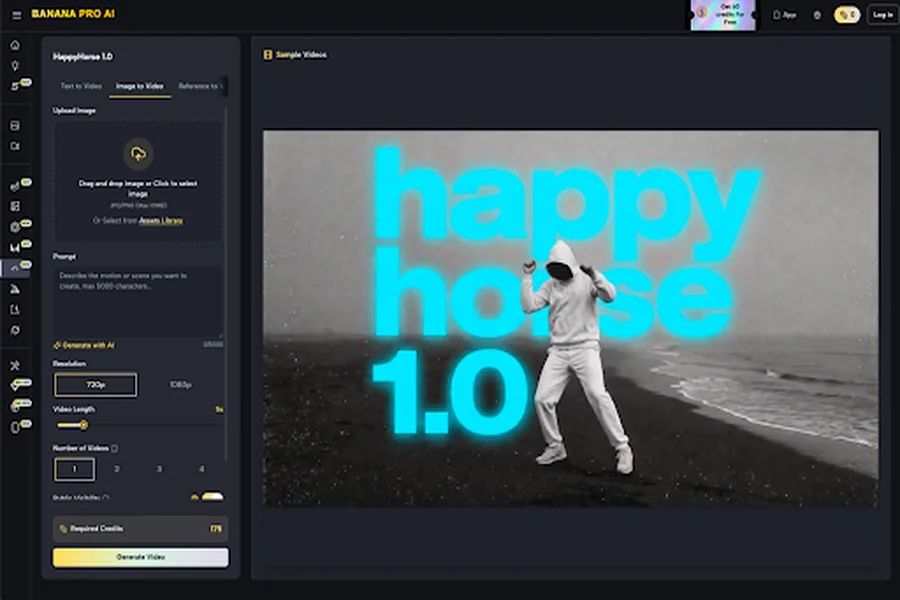
To get the best results from Nano Banana, the workflow should start with a dedicated refinement phase for the seed image. Using the tools available in Banana Pro, creators should look for “high-frequency textures” that might cause issues. These include fine patterns on clothing (moiré effects), thin wisps of hair against a complex background, or highly reflective surfaces.
- Manual Retouching: Before hitting the “generate video” button, use an AI Image Editor to smooth out areas of the image that don’t need to move. If you are animating a face, ensure the skin textures are consistent and that there are no stray pixels around the eyes or mouth that the AI might interpret as movement.
- Edge Consistency: Ensure that the edges of your subject are clean. If there is a “halo” or blur around the subject from a previous generation, the video model will likely turn that blur into a ghosting artifact once movement begins.
- Color Normalization: It is often safer to set the dynamic range of the seed image to a slightly more conservative level. If the shadows are “crushed” (pure black) or the highlights are “blown out” (pure white), the AI loses data in those regions. Keeping data in the shadows ensures that as the subject moves, the AI has a “memory” of what should be behind it.
While the Canvas Workflow allows for rapid iteration, the most successful creators are those who treat the first frame as a high-fidelity digital asset that must be polished before the temporal engine ever touches it.
What AI Cannot Solve: The Hard Limits of Current Temporal Consistency
Despite the rapid advancement of Nano Banana Pro and similar engines, there are physical and mathematical limits to what current generative models can achieve. It is important to reset expectations regarding “complex overlapping occlusions.”
An occlusion occurs when one object passes in front of another. In traditional 3D animation, the software knows that the object in the back still exists. In generative AI, the model has to “remember” the hidden pixels and recreate them once the foreground object moves. Currently, if an occlusion is too complex—such as fingers interlacing or a person walking behind a series of thin pillars—the model will almost certainly fail to maintain consistency. It will “forget” what the background looked like, leading to warping.
There is also the “4-second wall.” While we can extend video length through various stitching and interpolation techniques, the true temporal coherence of a single diffusion pass is still limited. We cannot yet predict with 100% certainty how a model will interpret non-Euclidean geometry—like a staircase that turns at an impossible angle—in a seed frame. Often, the AI will try to “correct” the geometry mid-motion, causing the entire scene to shift and melt.
Mastering the Input-Output Pipeline
The shift from “text-to-video” to “image-to-video” represents a maturing of the AI creative workflow. By focusing on latent fidelity and the structural integrity of the first frame, we move away from the lottery of random prompting and toward a predictable, repeatable production pipeline.
Investing ten minutes into refining a seed image in Banana AI or a similar editor is not a waste of time; it is a significant time-saver. It prevents the need for dozens of discarded video renders and the frustration of “almost perfect” clips that are ruined by a single flickering artifact.
The future of high-end generative media isn’t found in more complex prompts, but in the convergence of traditional photographic principles—lighting, composition, and clarity—with the power of the latent space. As we push the boundaries of what tools like Nano Banana can do, the first frame remains the most important frame. It is the physical anchor for the digital imagination, and its quality determines whether your video feels like a hallucination or a cinematic reality.

