
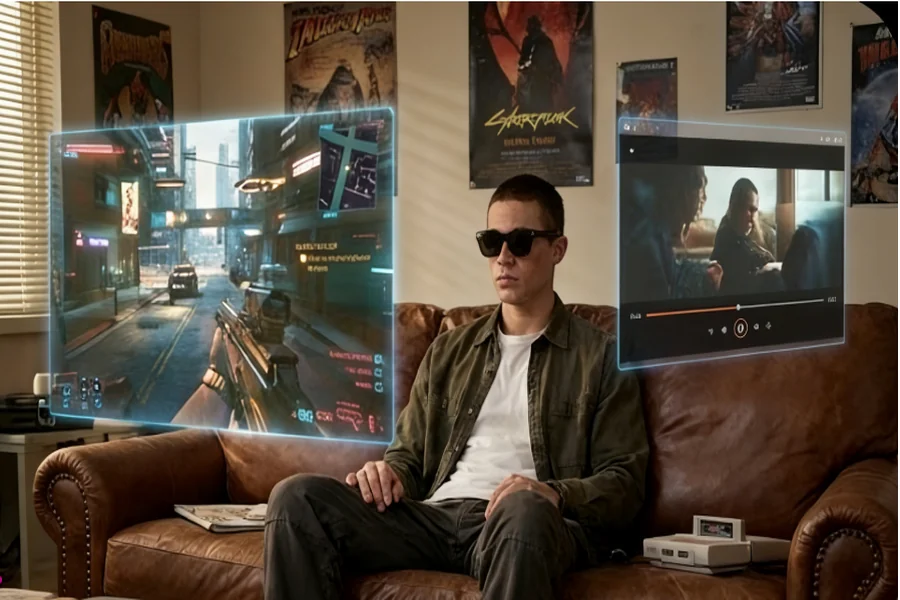
Retro gaming has grown into a multi-billion-dollar market. Millions of players now carry Steam Decks and emulation handhelds loaded with classic libraries. But 7-inch screens compress pixel art and strip out the visual depth that made those games iconic.
AR smart glasses offer a fix that VR headsets cannot: a massive private display without the bulk or isolation. One model has drawn steady attention from reviewers and portable gaming communities.
The RayNeo Air 4 Pro AR glasses for gaming connect via USB-C and project a 201-inch equivalent virtual display at 76 grams. The spec sheet makes a strong case for portable big-screen gaming.
What CRT Lovers Actually Miss
Retro gamers hunt down CRT televisions for a reason. Phosphor screens delivered true black levels, instant pixel response, and vivid color that modern LCDs still struggle to match. Those qualities shaped how classic games were designed to look.
CRTs weigh 50-plus pounds, break easily, and vanish from secondhand markets fast. Portable handhelds solved the weight problem but created a new one: a 7-inch display cannot reproduce the scale of an arcade cabinet or a 32-inch living room set.
That gap is where AR smart glasses step in. Like CRTs, Micro-OLED avoids LCD backlight bleed and can deliver deep blacks, though it does not recreate scanlines or phosphor glow. Current models project screens large enough to approach arcade-cabinet scale.
Why the Air 4 Pro Clicks With Retro Gamers
Not every pair of AR smart glasses suits retro gaming. Display technology, refresh rate, and brightness must clear specific thresholds. The RayNeo Air 4 Pro checks most of them at a price below its direct competitors.
Micro-OLED and True Blacks
The Air 4 Pro uses a SeeYa Micro-OLED panel with a 200,000:1 contrast ratio and 98% DCI-P3 coverage. Self-emitting pixels produce zero backlight bleed. Dark scenes in games like Castlevania or Metroid benefit from the high contrast and deep black levels.
HDR10 as a Differentiator
Among current competitors, the Air 4 Pro stands alone in listing HDR10. The RayNeo Air 4 Pro AR glasses for gaming use a Vision 4000 chip that can enhance SDR content with HDR-like processing, though results vary by source material and device.
120Hz for Frame-Perfect Gameplay
The RayNeo Air 4 Pro supports 120Hz output, which can improve motion clarity on compatible content. Most retro titles still run at 60Hz, but modern handhelds benefit from the higher refresh ceiling during menus, scrolling, and emulator UI navigation.
Brightness That Travels
At 1,200-nit brightness, the Air 4 Pro stays readable on airplanes and in sunlit rooms. The XREAL 1S peaks at 700 nits; the Viture Pro XR reaches about 1,000. That gap decides whether AR smart glasses work beyond the living room.
B&O Audio for Chiptune Soundtracks
The RayNeo Air 4 Pro houses four speakers co-tuned by Bang & Olufsen. The open-ear design works for casual play, though audio purists may prefer dedicated headphones. An optional Sound Tube directs output into the ear canal for added volume.
How It Compares to Competitors
Spec sheets matter more than marketing when the retro gaming community evaluates AR smart glasses. The table below compares the RayNeo Air 4 Pro against three direct competitors based on official product pages and verified review data.
| Feature | RayNeo Air 4 Pro | XREAL 1S | Viture Pro XR |
|---|---|---|---|
| Price | $299 | $449 | $459–$499 |
| HDR10 | √ | × | × |
| Resolution | 1080p/eye | 1200p/eye | 1080p/eye |
| Refresh Rate | 120Hz | 120Hz | 120Hz |
| Brightness | 1,200 nits | 700 nits | 1,000 nits |
| FOV | ~46° | 52° | 46° |
| Audio | B&O quad speakers | Bose speakers | Harman tuned |
| Weight | 76g | 82g | 77g |
| Myopia Dials | × (Rx lens frame included) | × | √ |
| Electrochromic Dimming | × | √ | √ |
The XREAL 1S offers higher per-eye resolution, a wider 52-degree field of view, and its own X1 spatial chip at $449. The Viture Pro XR adds built-in myopia dials and electrochromic dimming from $459. Neither currently lists HDR10, and both sit $150-plus above the Air 4 Pro on base price.
Plug-and-Play Setups for Retro Gaming
The retro gaming community values gear that works without configuration screens or companion apps. USB-C with DisplayPort Alt Mode handles the connection for most modern handhelds, making the RayNeo Air 4 Pro a plug-and-play accessory.
Steam Deck and PC Handhelds
The Steam Deck, ROG Ally, and GPD Win series support USB-C DisplayPort output directly. Plug in the RayNeo Air 4 Pro AR glasses for gaming and the 201-inch equivalent display activates without drivers, apps, or WiFi. Confirm your specific device supports DP Alt Mode before buying.
Nintendo Switch and Switch 2
Original Switch setups generally need a compatible dock or adapter such as the JoyDock ($89) to enable video output. Switch 2 is listed as compatible on the RayNeo product page. Factor in adapter costs when comparing total ownership across AR smart glasses brands.
Emulation Handhelds
Android-based devices like the Retroid Pocket 5 and Anbernic RG Cube support USB-C video output. These pair naturally with AR smart glasses for a large-screen emulation setup that fits in a backpack. Players running PS2, GameCube, or Dreamcast libraries see clear visual gains on a 201-inch equivalent screen.

What Could Be Better
No Built-In Myopia Adjustment
Users who need vision correction must order prescription lens inserts for the RayNeo Air 4 Pro, typically $50 to $150 depending on the provider. The Viture Pro XR includes rotary diopter dials that handle this adjustment out of the box.
Switch Adapter Adds Cost
The JoyDock runs $89. Combined with the $299 glasses, the total Switch setup reaches $388. Viture’s Mobile Dock lists at $129, bringing its bundle to around $588 at regular pricing. Both brands require adapter spending for Switch use.
Edge Softness and Fit Variance
Some reviewers note slight softness at the edges of the virtual screen. Comfort varies by face shape, and the nose pads may need repositioning to find the sharpest focal point. These are common trade-offs across display-class AR smart glasses at this price tier.
The Bottom Line
The retro gaming community gravitates toward gear that works without unnecessary complexity. At $299, the RayNeo Air 4 Pro combines HDR10 support, high brightness, 120Hz output, and B&O audio in a 76-gram frame. For players who miss CRT-era scale, these AR smart glasses offer one of the more compelling portable options available.

