
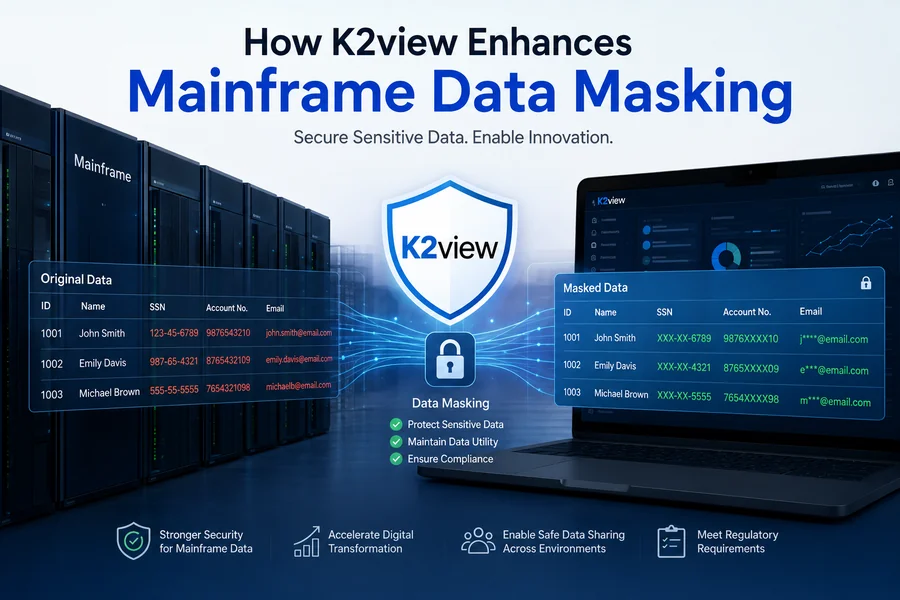
Mainframes are still at the heart of many critical businesses. Banks, insurers, airlines, governments – a lot of their most important systems still run on those big iron boxes. They’re stable. They’re fast. And they’ve been around for decades.
But they carry a lot of baggage. One of the biggest pieces of that baggage is sensitive data.
Think about what lives on a typical mainframe: customer records, account details, transaction histories, social security numbers, and health information. It’s a gold mine for attackers and a constant headache for security and compliance teams.
Most organizations know they can’t just leave that data wide open. So they try to mask it, especially in non‑production environments. Test, dev, QA, training. Anywhere real mainframe data is copied and used by people who don’t need to see the real thing.
On paper, that sounds straightforward. In reality, it’s messy.
Why mainframe masking is hard
Mainframes aren’t simple relational databases with nice, modern schemas. You’re dealing with COBOL copybooks, VSAM files, IMS hierarchies, packed fields, custom encodings, and decades of layering.
Often, no one person fully understands the entire data model anymore. The original designers may have retired. Documentation is patchy. And yet, you still have to protect that data without breaking the applications that rely on it.
Traditional masking approaches tend to fall into two camps:
- Homegrown scripts that do just enough to get by
- Point tools that treat mainframe like any other data source
Both have limits. Scripts are fragile, hard to maintain, and usually cover only part of the landscape. Generic tools may not really “get” mainframe structures, so you end up flattening data, exporting it, transforming it, and hoping it all lines up when you push it back.
This is where K2view takes a different route.
From files and fields to “business entities”
K2view doesn’t start with files and tables. It starts with business entities – customers, accounts, policies, claims, and so on.
Instead of saying, “Mask column X in file Y,” you define a data product for something meaningful, like a single customer. That product bundles everything related to that customer across the mainframe and any connected systems. Not just one file, but every place the customer appears.
Once you have that, you can define masking rules at the entity level. You don’t just randomize a name in one file. You mask the customer’s identity consistently wherever it shows up – in COBOL records, in DB2 tables, and in downstream analytics platforms.
That matters a lot for Mainframe data masking. You still want tests to behave realistically. You need the same “fake” customer to appear across multiple applications, so workflows, reports, and end‑to‑end scenarios continue to work.
Understanding mainframe formats
Mainframe data is not always intuitive. Fields can be packed decimals, binary flags, or encoded in ways that don’t survive naive masking.
K2view puts effort into understanding those structures properly. It can work directly with copybooks and mainframe formats instead of forcing you to export and reshape everything manually. That means when you mask a field, you preserve the format and length, so applications don’t crash or behave strangely.
For example, you can mask an account number but still keep the right number of digits and a valid check digit pattern. You can mask dates while keeping them in acceptable ranges. You can anonymize names and addresses but still maintain valid character sets and lengths expected by legacy programs.
So you protect the data, but you don’t destroy its usefulness.
Consistent masking across environments
Most organizations don’t have just one mainframe environment. They have a chain: production, QA, system test, user acceptance, training, maybe more.
Each environment needs data. And that data needs to be safe.
With K2view, you define your masking policies once, tied to those entity‑based data products. When you provision data into a non‑production environment, the masking happens as part of that provisioning process. Not as an afterthought. Not as a separate script that someone has to remember to run.
This does two things:
- It makes the process repeatable. You can refresh test data more often without reinventing the wheel every time.
- It makes compliance easier. When auditors ask how non‑production mainframe data is protected, you can point to a single, consistent framework instead of a mix of one‑off jobs.
Keeping relationships intact
One of the biggest complaints about masking is that it “breaks” the data. Relationships disappear. Scenarios don’t work. Testers lose confidence.
K2view’s entity model helps avoid that.
Because it treats something like a customer as a single data product, it masks all the related pieces together. The customer’s accounts, transactions, claims, and related parties all get transformed in a coordinated way. Keys and relationships are preserved, even if the underlying values change.
So you can still test things like the following:
- Multi‑account customer flows
- Cross‑system reconciliation
- End‑to‑end transaction journeys
You’re working with safe data, but the structure and relationships still feel real.
Speed and automation
Mainframes often sit at the center of complex release cycles. When you’re pushing changes, you can’t afford to wait days for test data to be prepared.
Once K2view is in place, provisioning masked data becomes part of an automated pipeline. Extract from production (or an approved subset), assemble by entity, apply masking rules, then push to the target environment.
You can schedule this. You can trigger it as part of CI/CD. You can refresh more often, with less manual effort from the mainframe team.
That means fewer bottlenecks, fewer late‑night jobs, and less reliance on a handful of experts who know how to run the old scripts.
Visibility and control
Masking decisions aren’t just technical. Security, privacy, legal, and business owners all care.
Because K2view centralizes the rules, it also centralizes visibility. You can see which attributes are masked, which methods are used, and where those rules apply. Changes are tracked. Policies can be reviewed and agreed on by the right stakeholders.
This is much easier to manage than a scattering of JCL jobs, shell scripts, and custom code. It also creates a cleaner story for regulators and auditors.
Beyond the mainframe itself
Modern architectures rarely keep mainframe data locked up on the mainframe alone. Data flows out to data warehouses, cloud analytics, CRM, and other systems.
K2view’s data products can extend beyond the mainframe boundary. Once a customer or policy is modeled as an entity, the same masking policies can apply as that entity is provisioned into other systems.
That gives you a more coherent protection model. You’re not safe on the mainframe and exposed everywhere else. You’re applying one set of rules across the broader landscape.
A more practical approach to mainframe data protection
Mainframes are not going away any time soon. They’re too valuable, too embedded, and too reliable. The challenge is to bring modern data protection practices to that world without breaking what already works.
K2view helps by changing the unit of work. Instead of thinking in files and columns, it thinks in people, accounts, and policies. It masks at that level, with an understanding of mainframe formats and constraints, and carries those rules across environments and systems.
The result is safer non‑production data, more realistic test scenarios, and a clearer governance story. You still get the resilience and performance of the mainframe, but with a more modern, controlled way to handle sensitive information.

