
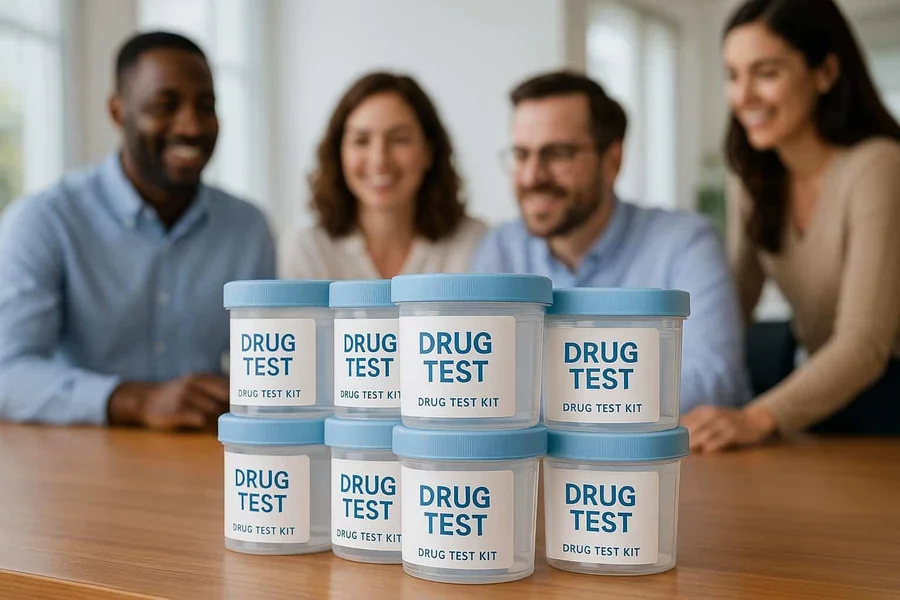
Drug testing used to live almost entirely inside laboratories. A sample was collected, packaged, shipped to a lab, and the result came back days later at clinical prices. For most of the people who need testing today, that workflow no longer matches the way the testing is actually used. Small employers running pre-employment and random screening, sober living homes monitoring residents, outpatient recovery programmes managing relapse risk, probation supervision, and families coordinating with a clinician all need fast answers at a price point that allows testing to happen frequently rather than rarely.
That shift has reshaped how the category is bought. Reliable instant urine drug test cups now sit in the one to three dollar range per unit when purchased through specialist suppliers, and bulk and promotional pricing pushes that figure lower. The result is a market where the cost of the test is no longer the limiting factor on how often a programme runs one.
Why the per-test cost matters more than people expect
A single screen looks cheap whether it is two dollars or five. The difference shows up at programme scale. A sober living home running random screening on twenty residents twice a month uses 480 cups a year. An employer running pre-employment, post-incident, and random testing on a workforce of one hundred easily clears 600 to 800 cups a year. At those volumes, the gap between three dollar cups and one-fifty cups becomes the difference between a programme that runs comfortably and one that quietly gets cut back when budgets tighten.
This is the reason promotional pricing and bulk discounts have become a normal part of how testing is procured. Specialist suppliers like 12 Panel Now run dedicated promotion pages where Discounted Drug Tests cover their core panel configurations, which lets programmes lock in a lower per-cup cost without changing manufacturer or panel structure.
What does not change at the discounted price
The temptation when buying cheaper cups is to assume something has been removed. With reputable suppliers, that is not how the discount works. The cups still need to carry CLIA-waived status and FDA clearance, the lateral flow assay technology behind the strips is the same, the temperature strip on the side of the cup is still there, and adulterant detection for things like creatinine, pH, oxidants, and specific gravity should still be integrated when the configuration calls for it. The discount comes from volume economics on the supplier side, not from cutting features on the cup itself.
Buyers should still verify four things on any discounted purchase. The specific panel configuration and which substances it detects. The CLIA waiver and FDA clearance documentation. The presence of temperature and adulterant safeguards built into the cup. And the expiration dating on the batch being shipped, since heavily discounted stock can sometimes be closer to expiry, which matters for programmes that rotate inventory slowly.
Where the savings show up in practice
Two scenarios make the impact concrete.
A small employer running a basic 12 panel screen on every new hire and a random 12 panel on existing staff each quarter. Moving from a three dollar per-cup baseline to a discounted price near one dollar fifty saves roughly one thousand dollars a year on a hundred-employee operation, which often pays for the entire testing line item.
A sober living home with sixteen residents running EtG and a 14 or 16 panel screen on a randomised schedule. Same dynamic, larger volume, savings often run into multiple thousands of dollars a year that get redirected into other resident support.
The point is not that drug test cups are expensive. They are not. The point is that at programme scale, the per-unit price decides whether testing happens at the right frequency.
How modern instant cups actually work
A modern cup is a sealed all-in-one container with integrated test strips inside the cup wall. The donor provides the sample directly into the cup. Lateral flow assay strips begin reacting immediately, and a control and test line on each strip indicates result within roughly five minutes. There is no transfer of urine between containers, no separate pipetting, and no waiting on a lab for preliminary results.
Built-in safeguards do the work that older formats relied on the tester to do manually. Temperature strips flag whether the sample is at body temperature, which makes substitution with cold water or synthetic urine immediately visible. Adulterant strips show whether the sample itself has been tampered with before any drug result is read. Non-negative results on the cup are then sent to a certified laboratory for confirmation by gas chromatography mass spectrometry or liquid chromatography mass spectrometry, which is the standard two-step testing approach used by professional programmes.
Frequently Asked Questions
Are discounted drug test cups less accurate? No. Reputable discounted cups are the same products at a lower price point. Accuracy is driven by the lateral flow assay technology, CLIA waiver, and FDA clearance, none of which change with a promotional discount.
Should buyers check the expiration date on bulk or discounted orders? Yes. Discounted batches can sometimes have shorter remaining shelf life. Programmes that rotate stock slowly should ask the supplier to confirm expiration dating before ordering large quantities.
How accurate are instant urine drug test cups in general? Reliable kits from established manufacturers report accuracy around 99 percent for preliminary screening. Any non-negative result should be confirmed by a certified laboratory.
Do all instant cups include temperature and adulterant safeguards? Most reputable cups include a temperature strip and adulterant detection. Buyers should confirm which safeguards are integrated in any specific configuration before ordering.
Can discounted bulk cups be used for legally relevant testing? The cup is the screening step. Any result used in a workplace, legal, or court-ordered context should be confirmed by a certified laboratory under documented chain of custody, regardless of whether the cup was purchased at standard or discounted pricing.
What panel sizes are typically available at a discount? Most specialist suppliers run promotional pricing across their core configurations, including 5, 10, 12, 14, and 16 panel cups, with EtG, fentanyl, and adulterant variations also commonly available.
How fast do instant cups produce results? Most cups produce a readable preliminary result within three to five minutes after the sample is collected.
