
When refrigeration fails, time compresses. Stock starts warming, service slows, and the risk of spoilage (or worse, a food safety incident) climbs by the minute. Whether you’re running a restaurant, care home, laboratory, event site, or distribution hub, the decision you make in the first hour often determines whether the problem becomes a contained disruption—or an expensive, reputationally damaging emergency.
The good news is that emergency cold room or freezer hire can be a genuine lifeline. The challenge is choosing the right solution under pressure, when you’re juggling engineers, staff, and anxious stakeholders. Here’s a practical way to make that choice quickly and confidently.
Start with the non-negotiables: what must be protected?
Before you call anyone, get clear on three basics. They sound obvious, but they prevent costly mismatches.
1) What temperature range do you actually need?
A “cold room” and a “freezer” are not interchangeable. Many businesses need one of these typical bands:
- Chilled storage (commonly +1°C to +5°C): fresh meat, dairy, prepared foods, medicines.
- Frozen storage (typically -18°C or below): frozen ingredients, ice cream, long-hold stock.
- Controlled chilled (e.g., +8°C to +15°C): some produce, certain clinical supplies.
If you’re unsure, check your HACCP plan, supplier specifications, or product labels. In a crisis, guessing can lead to partial thawing, quality loss, and avoidable waste.
2) How much volume needs saving right now?
Don’t just estimate in “boxes” or “trays.” Think in usable pallet positions or shelving metres. A trailer that looks big can feel cramped once you account for:
- airflow clearance around walls and evaporators
- safe access for staff
- segregation of allergens or raw vs ready-to-eat items
If you only have ten minutes, count the number of standard roll cages or pallets you need to protect in the next 12–24 hours.
3) How quickly must it be on site—and for how long?
A two-hour gap needs a different approach than a two-week repair. Your hire choice should match the timeline:
- Short outage (hours): rapid deployment, stable temp recovery, simple access
- Medium (days): efficient power use, shelving options, defrost management
- Long (weeks): reliability, monitoring, service response, clear maintenance terms
Choose the right format: trailer, modular cold room, or walk-in?
Once you know temperature, volume, and timeline, you can select a format that fits your site and operations.
Trailer-mounted units: speed and flexibility
Refrigerated trailers are often the fastest option because they arrive as a self-contained “plug in and go” solution. They’re especially useful when internal space is limited or when you need temporary capacity outside a back door for fast loading.
If you’re dealing with an unexpected breakdown and need short-notice fridge and freezer hire for urgent needs, trailer-based options can be a practical first move because they’re designed for rapid mobilisation and straightforward setup on many sites.
Modular cold rooms: best when you have indoor space and a longer window
If you have access to a loading bay or spare indoor area, a modular cold room can offer a larger footprint and more custom layout. The trade-off is that it usually requires more setup time and coordination.
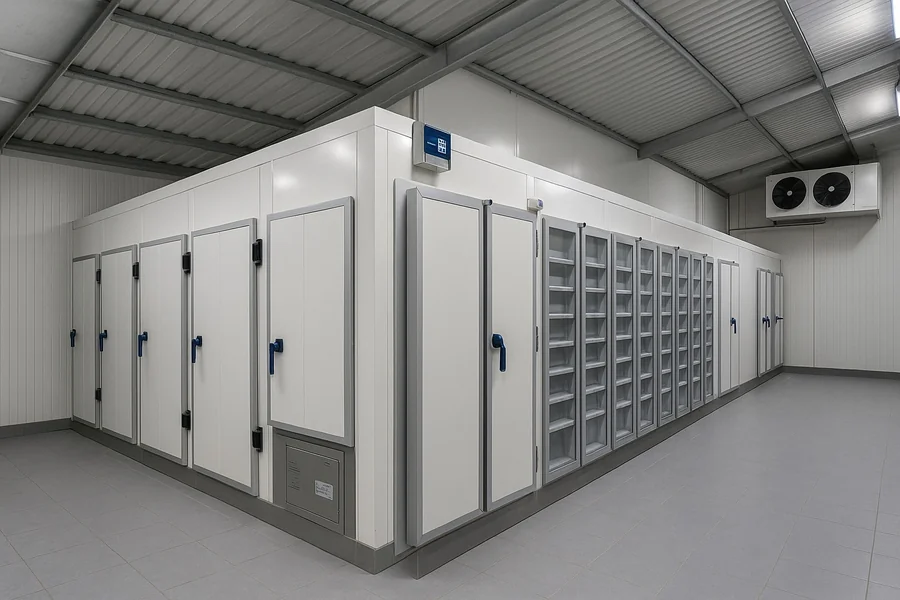
Walk-in freezer units: specialised but essential for deep-frozen stock
Freezers are less forgiving than chillers. Pull-down time, door discipline, and airflow become critical, particularly for already-frozen goods. If your stock must remain at -18°C or below, don’t accept a “near enough” spec.
Ask the questions that prevent nasty surprises
In emergencies, people focus on availability. Availability matters—but so do the details that determine whether the unit actually performs.
Power requirements and site compatibility
Confirm:
- Power supply type: 13A plug, 16A commando, 32A, or three-phase
- Cable length and routing: can you reach a safe socket without trailing hazards?
- Generator compatibility: if your site power is compromised, what size generator is needed?
A unit that turns up without a workable power plan wastes precious time.
Temperature recovery and loading discipline
If you’re moving stock from a failed cold room, it may already be warming. Ask how quickly the hired unit can pull down to target temperature—and plan loading so you don’t sabotage performance. Practical tips:
Keep doors closed between loads, load in batches, and avoid stacking product tight to internal walls where airflow is needed.
Monitoring, alarms, and compliance
For many operations, “it felt cold” isn’t a record. Ask whether the unit supports temperature display, data logging, or remote monitoring. If you’re in food service, the Food Standards Agency expects operators to maintain safe temperatures and demonstrate control. In pharma or lab settings, documentation can be even more critical.
Hygiene and cross-contamination controls
In a crisis, it’s easy to ignore cleaning—until an allergen or raw/ready-to-eat issue creates a second incident. Check whether the unit arrives cleaned and ready, and whether shelving, liners, or racking options are available for separation.
Plan for access, workflow, and the human factor
Even the perfect technical solution fails if it disrupts how your team works.
Site placement and access
Think through:
- turning space for delivery vehicles
- ground firmness and level parking (important for trailer doors)
- safe pedestrian routes for staff carrying stock
- proximity to your kitchen/production area to reduce door-open time
If possible, do a quick “walk path” from your stock area to the proposed unit location. In a rush, every extra step gets repeated hundreds of times.
Operating practices that protect temperature
Small behaviours make a big difference:
- assign one person to manage loading to reduce door-open time
- use strip curtains if available
- stage product in a shaded area (never in direct sun) for quick transfer
- label zones inside the unit to avoid rummaging with the door open
These aren’t fancy strategies—just practical habits that help the hired unit do its job.
Don’t ignore the contract details—especially in an emergency
When you’re under pressure, you may accept vague terms. Resist that temptation. Clarify:
Call-out and support response times
If the hired unit alarms at 2 a.m., who answers? What’s the expected response window? Emergencies don’t respect office hours.
Fuel, servicing, and responsibility boundaries
If the unit needs servicing, defrosting guidance, or generator fuel, make sure responsibilities are clear. Ambiguity here causes delays when you can least afford them.
Extension flexibility
Repairs often overrun. Choose a hire arrangement that can extend without a complicated rebooking process.
A simple way to decide—fast
In practice, the “right” choice usually comes down to balancing four factors: speed, temperature certainty, capacity, and site fit. If you can tick those boxes—and confirm power and monitoring—you’re most of the way there.
A final thought: once the immediate crisis is contained, take 30 minutes to document what happened and what you’d do differently next time. The best operators treat emergency hire not as a one-off scramble, but as part of their resilience plan. That small bit of learning is often what turns the next crisis into a manageable inconvenience.

