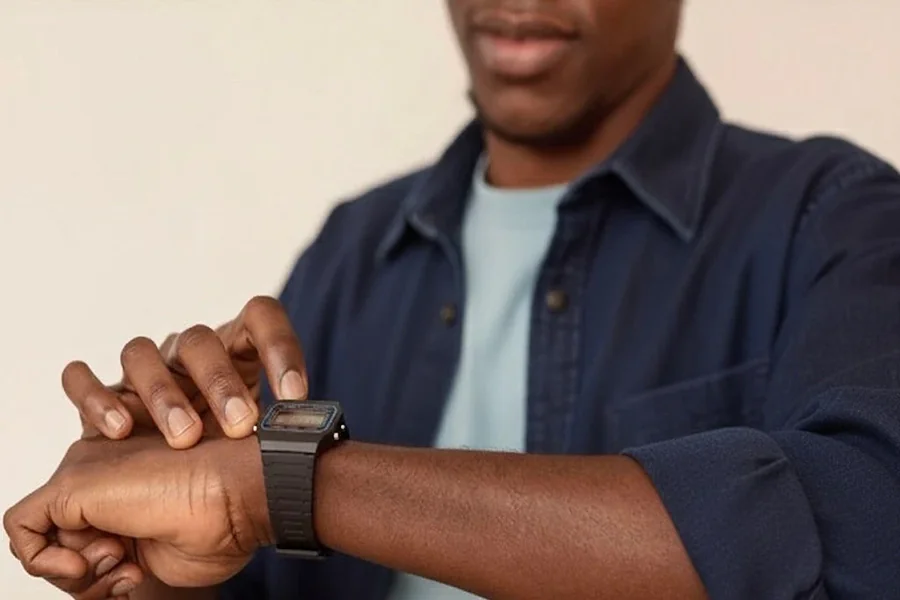
Most watches are built for the life you’re supposed to live. G-Shock builds for the one you actually do. The dropped phone, the rushed commute, the weekend that got more physical than planned. Durability isn’t a feature G-Shock adds to its watches. It’s the entire starting point. In reality, what actually happens is different, and here’s why it matters more than the spec sheet suggests.
It Started With a Watch Hitting the Floor
In 1981, a Casio engineer named Kikuo Ibe watched his father’s pocket watch shatter after a short fall. That moment became an obsession. After two years of creating prototypes, he got something that finally survived. The result was the first G-Shock, released in 1983. Four design principles came out of that obsession for G-Shock watches, and none of them have been abandoned since then:
- A floating module suspended inside the case to absorb shock rather than transfer it to the movement
- A protective carbon or resin exterior built to take impact without fracturing under stress
- Reinforced buttons and crown engineered to resist both pressure and debris at the same time
- A structure where the intentionally weakest point is still stronger than any force it’s realistically likely to face
That’s not a marketing brief. That’s the actual physical architecture of every G-Shock ever made. This is also the reason why these watches routinely survive things that would turn anything else into an expensive pile of parts.
What ‘Shock Resistant’ Actually Means
The ISO shock resistance standard requires a watch to survive a one-metre drop onto hardwood flooring. It’s a reasonable baseline. Most quality watches meet it. G-Shock doesn’t use it as a ceiling. It uses it as the starting point for the conversation.
To understand the gap, it helps to see it laid out directly:
| Feature | Standard Watch | G-Shock |
| Drop resistance | ~ 1 metre onto hardwood | Multi-directional impact far exceeding the ISO standard |
| Vibration tolerance | Basic daily movement | Tested against industrial-level vibration frequencies |
| Temperature range | Moderate ambient conditions | Extreme cold and heat without lubricant failure |
| Movement protection | Direct case contact | Floating module, fully isolated from the outer |
| Water resistance | Varies widely | 200m standard across most models |
For the average person, this translates into something genuinely freeing. You stop treating your watch like something breakable.
Solar Power and the End of the Dead Battery Problem
Battery anxiety is more disruptive than people want to admit.
You glance down during something important, and the watch has stopped. Or you remember, three weeks too late, that you still haven’t replaced the battery you noticed dying last month.
G-Shock watches like GSTB500BD-1A9 remove that variable completely. The solar charging system converts both natural and artificial light into stored energy and runs continuously without any manual input from you.
The stainless steel construction shifts it away from the traditional G-Shock utilitarian aesthetic toward something cleaner and more considered, allowing it to transition from a work environment to a weekend without any visual awkwardness.
The Average Person Doesn’t Live an Average Life
This is where most “tough watch” marketing completely loses the plot.
The imagery defaults to mountaineers, military operators, and commercial divers. It’s visually compelling. It’s also irrelevant to the vast majority of people wearing these watches, whose weeks involve none of that and still somehow manage to be genuinely punishing on a timepiece.
A realistic week looks more like this:
- A gym session where your wrist catches the barbell rack on the way up
- A weekend project involving power tools, concrete dust, and unplanned trips
- A commute where your bag snags something and your watch takes the full rotational force of your arm
- Travel through multiple time zones, temperature swings, and a security tray that hits harder than it looks
None of this qualifies as extreme. All of it is real, and it’s exactly what the G-Shock G-Steel 2100 is built to absorb without complaint.
Design That Stopped Apologising for Being Tough
For a long time, durability came with an aesthetic penalty. You got the toughness and gave up the hook. That trade-off no longer exists, and G-Shock is a major reason why.
The G-Shock GMS2110-1A1 makes the argument visually. The silver case against black resin creates a contrast that reads as deliberate rather than industrial.
The analogue-digital display handles legibility and functionality together without crowding the dial with information you don’t need at a glance. It looks like a watch that was designed to be worn consistently, which is exactly what it was.
Built for Real Life
Durability isn’t about bracing for disaster but removing friction from the ordinary.
A watch that survives your real week without asking for anything in return is worth considerably more than a delicate piece that requires constant care and handling. G-Shock worked that out in 1983. The average person is still catching up. Now you know exactly where to start.