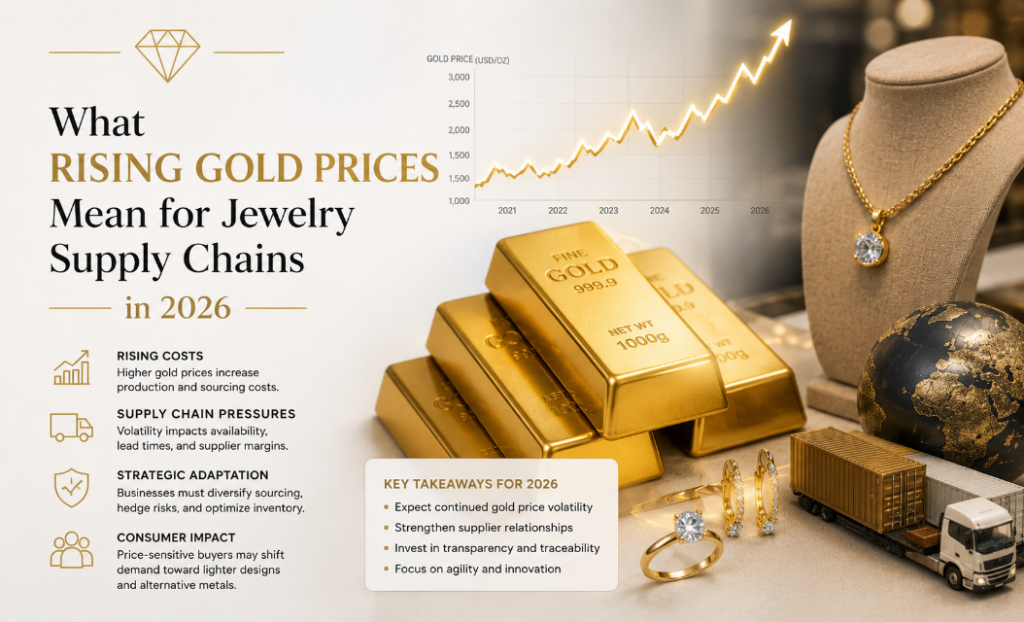
Gold has had a wild run. Spot prices climbed well past where most people in the trade expected them to land this year, and anyone buying or selling jewelry for a living has felt it somewhere along the chain. It’s one thing to watch a price chart move. It’s another to be the retailer who has to explain to a longtime customer why a piece that cost $400 last spring is $520 now, or the buyer trying to figure out whether to place a bigger order before the next price jump or wait it out.
The obvious effect: everyone’s cost basis moved
Start with the simple part. Gold is priced by weight and purity, so when spot price rises, the raw material cost of every single piece rises with it, whether it’s a delicate chain or a heavy statement bracelet. That part isn’t complicated. What’s more interesting is how differently that cost increase ripples through each link in the chain depending on where they sit.
A gold jewelry manufacturer buying raw metal in bulk has some ability to hedge, lock in pricing on forward contracts, or time large purchases around dips. A small retailer buying finished pieces doesn’t have that flexibility. They’re taking whatever price the wholesale side is charging that month, and if they don’t adjust their own retail pricing fast enough, their margin quietly erodes without anyone noticing until the quarterly numbers come in.
Heavier categories feel it first
Not every product category takes the same hit. A pair of delicate stud earrings uses a small enough amount of gold that a price swing barely moves the finished cost. Chunkier pieces are a different story. Anything sold as gold bracelets wholesale tends to use significantly more metal per unit than earrings or thin rings, which means bracelet pricing is far more sensitive to spot price movement. Retailers who stock heavy in bracelets have had to rework their pricing sheets more often this year than those leaning toward lighter categories.
This has quietly nudged some buyers to shift their category mix. A few retailers mentioned pulling back slightly on the heaviest bracelet and chunky ring styles and leaning a bit more into earrings and thinner pieces, simply because the price volatility is easier to absorb there. It’s not a dramatic pivot, more of a hedge against unpredictability than an actual change in what customers want.
Made-to-order gets trickier when prices move fast
One underappreciated wrinkle: made-to-order production, which usually takes weeks between quote and delivery, gets genuinely awkward when spot price is moving as fast as it has this year. A manufacturer quoting a price in January based on that week’s gold price is taking on real risk if the piece isn’t finished and shipped until March, especially on larger custom orders. Some manufacturers have started building in price adjustment clauses tied to spot price at time of production rather than time of quote, which protects them but can catch retailers off guard if they’re not expecting it. Worth asking about explicitly before placing a big custom order right now.
What retailers are actually doing about it
The practical responses have been fairly consistent across the independent retailers who’ve talked about this openly. Smaller, more frequent orders instead of one large seasonal buy, which limits exposure to a single price snapshot. More conversations with suppliers about price locks or short-term holds on quoted pricing. And a general move toward being upfront with customers about why prices have shifted, rather than quietly adjusting tags and hoping nobody notices.
There’s also been a modest uptick in interest around 10 karat and 14 karat pieces over 18 karat, simply because the lower gold content means the metal cost swings less dramatically in dollar terms, even though the percentage swing is the same. It’s not a wholesale shift in demand, more a hedge some retailers are making on their own inventory mix.
Where this settles
Nobody in the trade seems fully confident about where gold prices go from here, and honestly, that uncertainty is the real story. What’s changed isn’t just the number on the price chart. It’s that retailers and manufacturers alike are having to build more flexibility into how they quote, order, and price, because the old assumption of relatively stable gold cost from quarter to quarter doesn’t hold the way it used to. Whether that becomes the new normal or settles back down by next year is anyone’s guess. For now, the businesses handling it best seem to be the ones staying in closer, more frequent contact with their suppliers rather than locking into big orders and hoping the price holds steady.